Amazon's recommendation engine has been quietly rebuilt. The algorithm that decides whether your product gets seen or buried in 2026 isn't the one most sellers are still optimising for.
At RootAMZ, we audit listings every week where the keywords are right, the reviews are solid & the price is competitive yet visibility is falling. The reason, almost every time, is the same: the listing was built for the old algorithm & never updated for the new one.
Here's what changed & what to do about it.
Amazon Now Runs Three AI Systems Simultaneously
Your listing is no longer evaluated by one algorithm. It's evaluated by three, running in parallel.
A10 still handles traditional keyword matching titles, bullets, backend search terms. It hasn't disappeared & keyword relevance still matters.
COSMO is Amazon's intent engine. It doesn't match what the shopper typed. It infers what the shopper actually wants based on billions of search & purchase behaviours, then surfaces products whose listings communicate the right attributes even if the exact words don't match.
Alexa for Shopping (rebranded from Rufus in May 2026) is the conversational layer. Shoppers ask natural questions & Alexa narrows the entire Amazon catalogue down to roughly five recommended products. If your listing isn't one of them, you don't exist for that query.
Optimising for A10 alone which is what most sellers are still doing means you're visible to one system & invisible to the other two.
Write Listings for Intent, Not Just Keywords
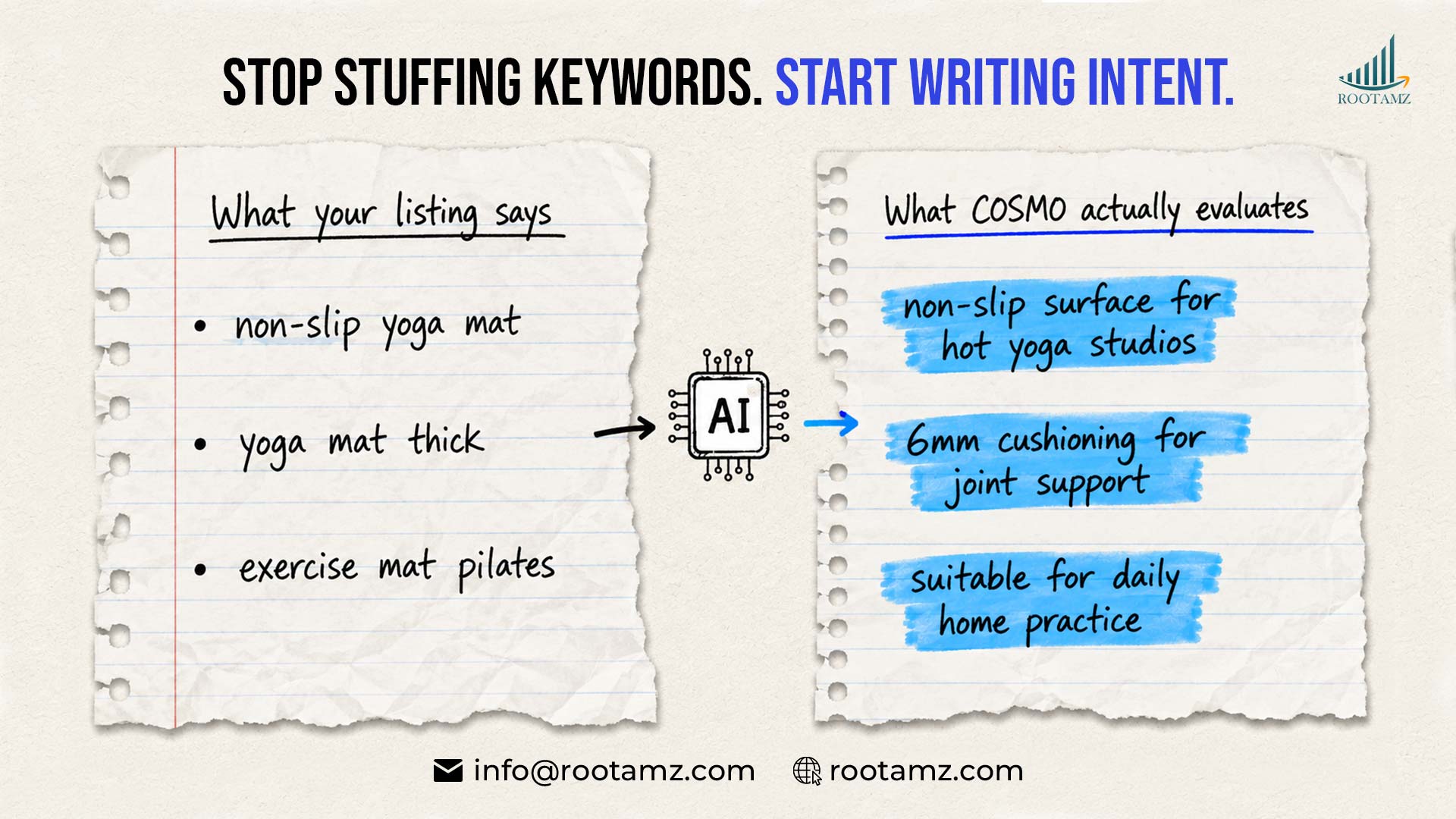
COSMO reads your listing the way a knowledgeable shopper would. It's looking for what the product is, who it serves, what problems it solves & what specific use cases it fits.
A bullet that reads "yoga mat non-slip yoga mat thick yoga mat for hot yoga" tells COSMO almost nothing. A bullet that reads "6mm cushioning for joint support during hot yoga & daily home practice, non-slip surface tested on hardwood & studio floors" gives it everything it needs to match your product to the right intent.
The practical shift: write every bullet to answer a real shopper question, not to repeat a keyword. Keyword density is counterproductive with COSMO it actively reduces semantic clarity.
Fill the Backend Attributes Your Competitors Ignore
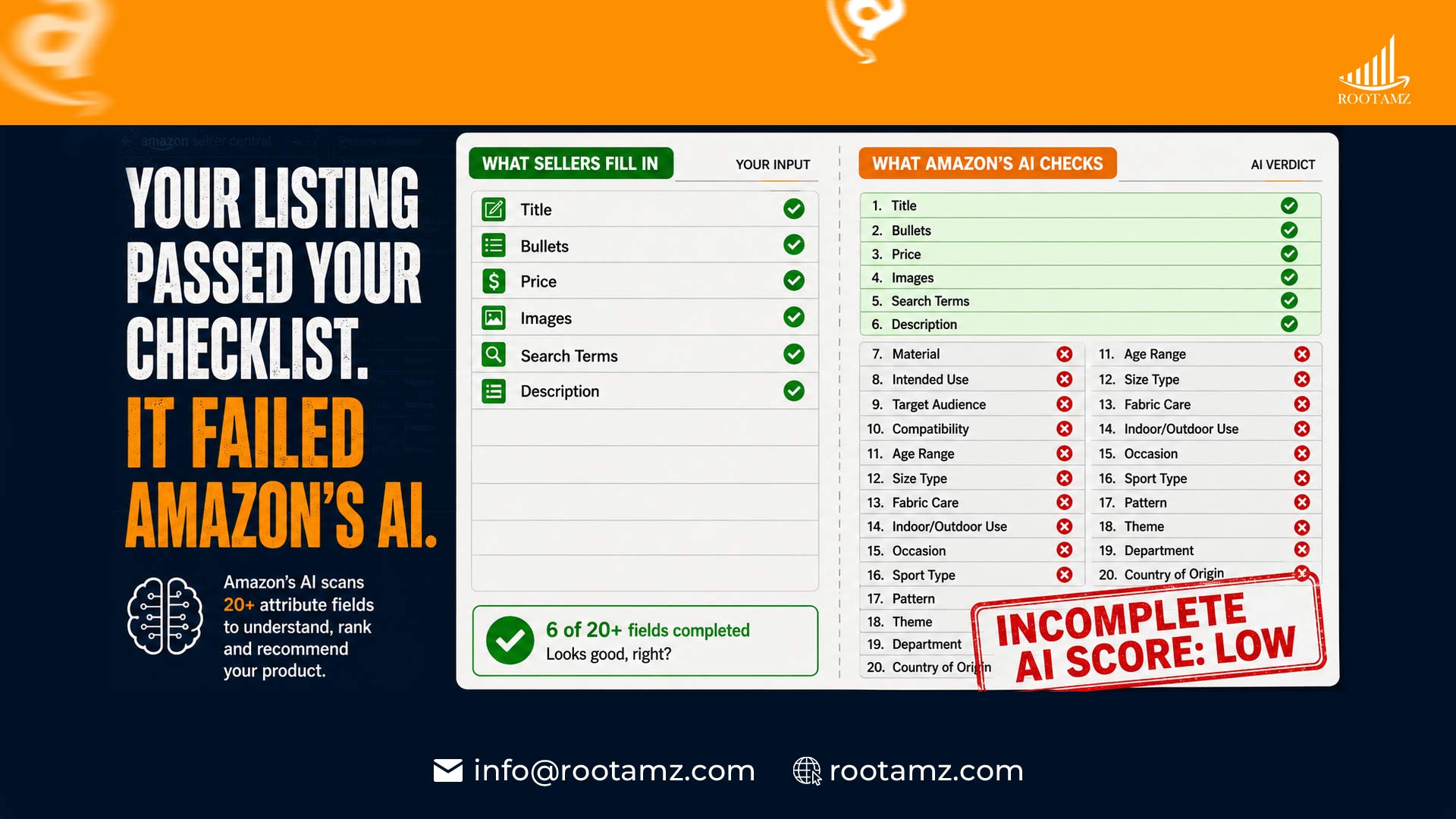
Amazon's catalogue contains over 750 structured data fields used by its AI for ranking & discovery. Most sellers complete 10 to 15 of them.
COSMO filters by these structured attributes before it evaluates your listing copy. Material composition, intended use, target audience, compatibility, size range these backend fields are the gates your product must pass through to be considered for a recommendation. Empty fields mean the AI can't confidently categorise you. & products it can't categorise confidently, it doesn't recommend.
Filling your backend attributes completely is the highest-leverage, lowest-visibility optimisation available on Amazon right now & the one most sellers & agencies never address.
How RootAMZ Optimises for Amazon's Full AI Stack
At RootAMZ, an Amazon Ads Verified Partner, our listing optimisation covers all three AI layers:
AI-mapped listing copy titles, bullets & descriptions written for COSMO intent & A10 keyword relevance simultaneously
Full backend attribute completion all applicable structured fields filled across your entire catalogue
Alexa for Shopping readiness Q&A, review strategy & A+ Content structured for conversational AI discovery
Sponsored Prompts setup now out of beta & billable from March 2026, we build campaigns that surface inside the AI recommendation layer directly
FAQ's
What is Amazon Rufus & how does it affect my listings?
Rufus is Amazon's AI shopping assistant. It reads your whole listing to answer shopper questions in plain language, so listings that are clear & genuinely informative are far more likely to get recommended.
Do I need to strip the keywords out of my listing for Rufus?
No, not at all. Keywords still matter for normal search & indexing. What's changed is that they need to sit inside real, clear product information - not just be repeated for density's sake.
Does Rufus actually read my customer reviews?
Yes. It pulls from reviews & Q&A to understand what real buyers are actually worried about, which is exactly why an unanswered question on your listing is a missed opportunity.
Is Rufus just another name for COSMO?
No, they're different things. COSMO is the underlying search & ranking algorithm. Rufus is the actual conversational assistant that uses COSMO's understanding to give shoppers a direct answer.
Can RootAMZ help optimise my existing listings for this?
Yes. RootAMZ audits & rewrites listings, A+ Content & backend data to work with AI-driven discovery, without losing the keyword rank you've already built up.