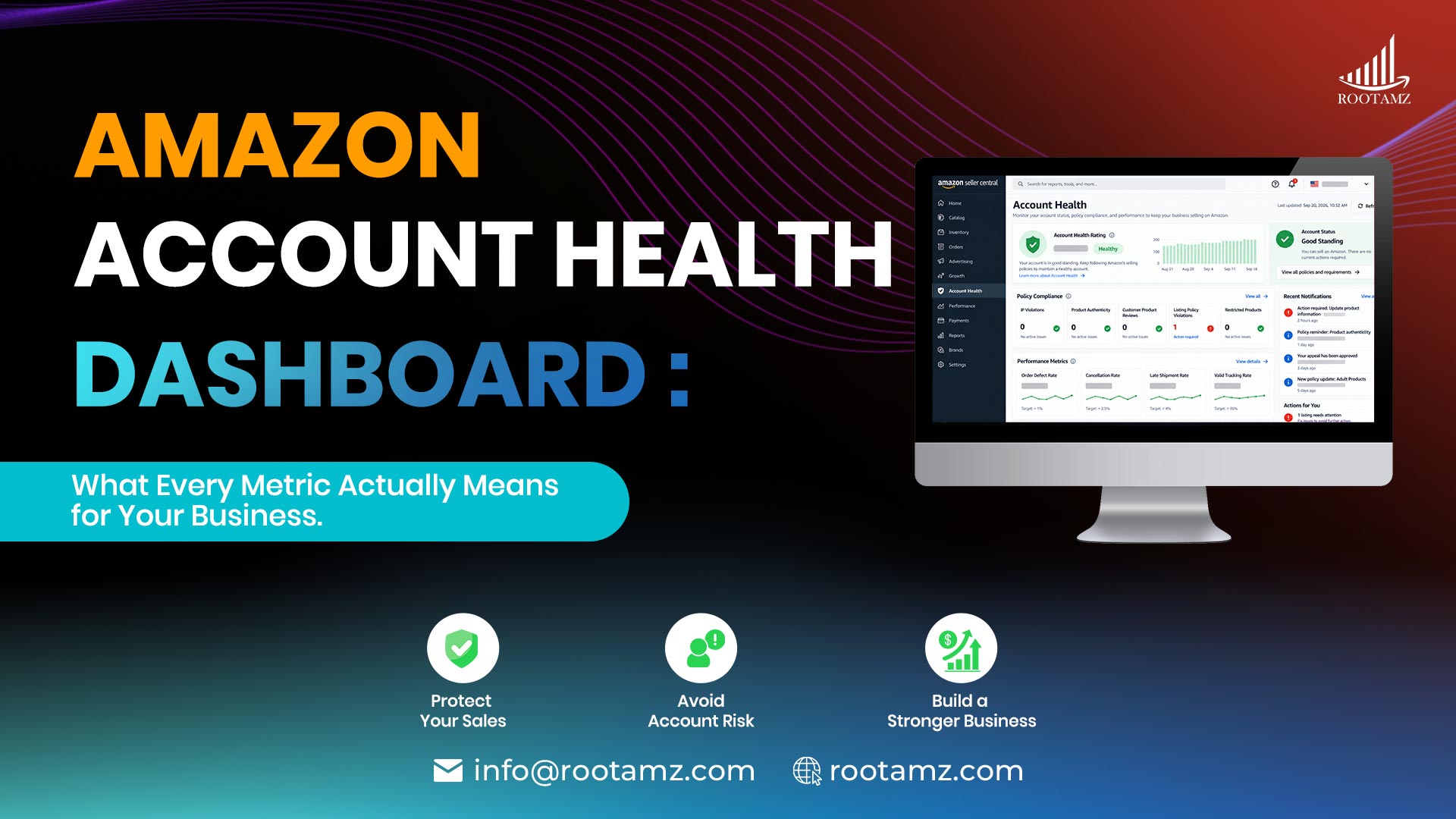
Most sellers only open their Account Health Dashboard when something goes wrong. A notification lands. A listing disappears. A metric they didn't know existed has quietly turned red.
That's the wrong relationship to have with it.
In 2026, your Account Health Dashboard is effectively Amazon's real-time risk file on your business. It doesn't just tell you whether you're compliant right now it signals where problems are building before they become expensive. The sellers who treat it as a weekly management tool are the ones who rarely end up firefighting. The ones who ignore it until Amazon forces their hand are the ones calling us in a panic on a Tuesday morning.
Here's what each area actually means for your business.
🔎 What Is the Amazon Account Health Dashboard?
It's not a simple pass-or-fail score. Think of it as an early-warning system across five operational areas policy compliance, performance metrics, intellectual property, product compliance, and regulatory requirements.
The trap most sellers fall into is looking at the score rather than what's driving it. A score can look acceptable on a Tuesday while an unresolved IP complaint quietly builds into a listing suspension by Friday. The number is the output. The business problem underneath it is what needs attention.
1. Intellectual Property Violations & Fake DMCA Claims 🚨
IP complaints are one of the most stressful account-health problems and one of the most mismanaged.
The mistake sellers make is treating an IP complaint like a customer service ticket to close quickly. It isn't. If someone has filed a complaint claiming ownership of your product images, your brand name, or your packaging design, you need to establish exactly what's being alleged before you respond to anything.
Start by identifying what Amazon says has been violated images, descriptions, logos, product design, trademarks. Then gather the evidence that supports your position: original creative files, ownership documentation, manufacturing invoices, trademark registrations. Your response needs to be built around facts and documentation, not a counter-accusation.
The deeper question is always why the complaint happened. A one-off dispute from a competitor is different from a systemic issue with your brand protection setup. Treating them the same way creates repeat problems.
2. The "Compliance Trap" & Listing Rewrites
This one catches sellers off guard more often than any other account-health issue.
You get a compliance flag. You fix the specific thing Amazon highlighted. Then another flag appears. You fix that. Then the listing that was once converting at 18% is now sitting at 11% and nobody's quite sure why.
That's the compliance trap making reactive changes to individual issues without looking at what the listing actually needs to say.
Removing an unsupported performance claim might be necessary. But simply deleting the sentence leaves the listing weaker. A better approach is replacing problematic language with accurate, specific product information that does the same commercial job without the compliance risk.
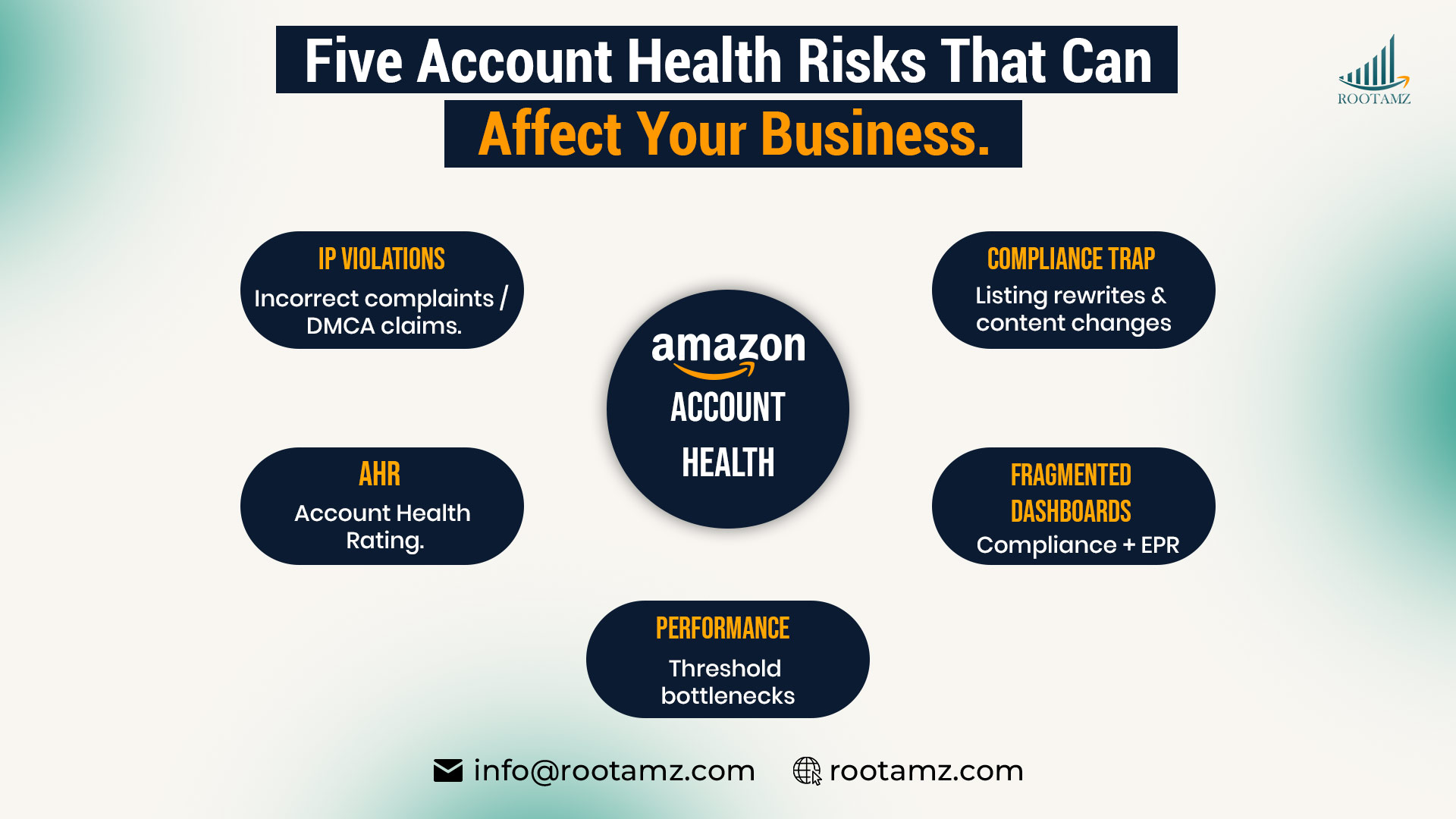
3. Account Health Rating Deflation 📉
When the Account Health Rating drops, the natural reaction is "why did my score go down?" That's the wrong question.
The right question is: what underlying issue caused this?
A score is an output. The policy or performance problem underneath it is what you actually need to fix. This matters especially when you're managing a large catalogue a small problem repeated across twenty ASINs becomes a significant operational workload very quickly if you're only tracking the score rather than the root cause.
The workflow that works: identify the policy issue → find the affected ASINs → establish the root cause → document corrective action → monitor for recurrence. That process turns account health from a reactive scramble into a manageable system.
4. Fragmented Dashboards: Compliance & EPR
For sellers operating across multiple EU marketplaces, account health becomes genuinely complicated by fragmentation.
Policy compliance sits in one dashboard. Product compliance information sits somewhere else. EPR registration requirements vary by country. And if your catalogue data is being maintained manually across spreadsheets, you will at some point have one marketplace showing updated information while another is running on outdated data.
The solution isn't more spreadsheets. It's a structured product-data workflow where one reliable source feeds every marketplace consistently so when Amazon Germany asks for updated responsible person information, you're not searching three folders and two email chains to find it.
5. Performance Threshold Bottlenecks ⚠️
Not every account-health problem arrives dramatically. Some build slowly through performance metrics that inch toward a threshold over weeks.
The sellers who stay out of trouble here aren't the ones watching the dashboard every day. They're the ones investigating the business problem behind the metric rather than managing the number itself.
If a particular product is repeatedly generating customer complaints check the listing, check the images, check the packaging, check the instructions. Fix the source. Resolving each complaint individually while the product keeps generating new ones isn't account-health management, it's treading water.
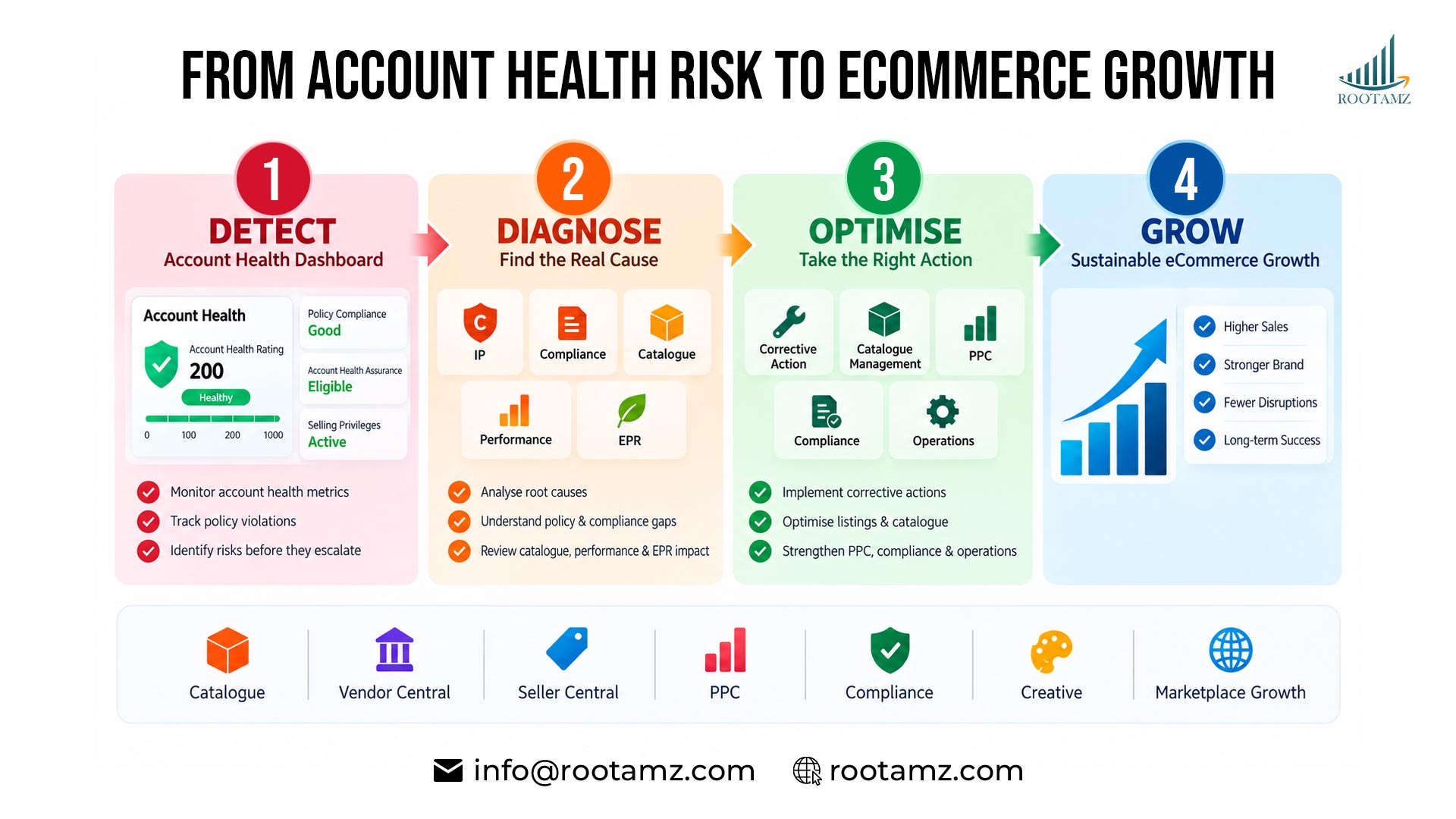
🛡️ How RootAMZ Turns Account Health Into a Business Process
Account health doesn't sit separately from the rest of your Amazon operation. It connects directly to your catalogue, your listings, your advertising, your inventory, and your customer experience. A weak link in any of those areas shows up in the dashboard eventually.
RootAMZ's Amazon Seller Central Management treats account health as one part of a connected system not a standalone dashboard to check when something goes wrong.
Services RootAMZ Provides:
Amazon Seller Central Management ongoing account health monitoring, policy compliance tracking, and early-warning escalation across all ASINs.
Amazon Listing Optimisation compliance-led listing audits that resolve policy issues without sacrificing conversion performance.
Amazon PPC Management advertising strategy that accounts for catalogue and account health status, so spend isn't directed at at-risk listings.
IP & Compliance Support investigating complaints, organising documentation, and coordinating structured responses.
Amazon Vendor Central Management account health monitoring extended to Vendor Central operations and chargeback management.
Multi-Marketplace Management consistent catalogue and compliance standards across Amazon, Walmart, and eBay simultaneously.
As an Amazon Ads Verified Partner, RootAMZ connects account health and catalogue management directly with a performance-focused advertising strategy because there's very little point in scaling ad spend on a catalogue that has unresolved compliance issues underneath it.
Talk to RootAMZ today.Get in touch for an Amazon Account Health and Marketplace Audit.
FAQ's
What is the Amazon Account Health Dashboard?
It is Amazon's central area for sellers to monitor account-level performance, policy compliance & other issues that can affect selling privileges.
Can an incorrect IP complaint affect my Amazon account?
Potentially, yes. An intellectual-property complaint can require action & documentation. Sellers should investigate the specific complaint & provide an evidence-based response through the appropriate Amazon process.
What should I do if Amazon asks me to rewrite my listing?
First identify exactly what Amazon is asking you to correct. Then make accurate, supportable changes without unnecessarily removing useful product information.
How can I prevent account-health problems?
Use proactive monitoring. Review policy notifications, catalogue compliance, performance indicators, customer feedback & recurring operational issues regularly.
Can RootAMZ manage my complete Amazon account?
Yes. RootAMZ supports catalogue management, Vendor Central operations, listing optimisation, compliance, PPC & Amazon Ads, creative services, A+ Content, account-health workflows & broader eCommerce growth management.