Most sellers find out about EU compliance problems the same way. An email from Amazon. A listing deactivated. A product they've been selling for two years suddenly unavailable in Germany, France, or Spain with no clear explanation of what went wrong or how quickly they can fix it.
The problem usually isn't the product. It's the data behind it.
In 2026, two major EU frameworks are now active and moving the General Product Safety Regulation and the Digital Product Passport. If you sell consumer products into Europe and haven't reviewed your compliance position, this is the moment to do it. Waiting for Amazon to flag a listing is not a strategy. By then, you're already losing sales.
GPSR This One Is Already in Force
The General Product Safety Regulation came into full effect on 13 December 2024. It isn't coming. It's here. And Amazon has already been removing non-compliant listings across EU marketplaces.
GPSR applies to most non-food consumer products sold to EU customers household items, electronics, clothing, toys, pet products, furniture. If you're selling into Germany, France, Italy, Spain, or any other EU marketplace, it almost certainly applies to you.
Here's what Amazon actually requires sellers to provide:
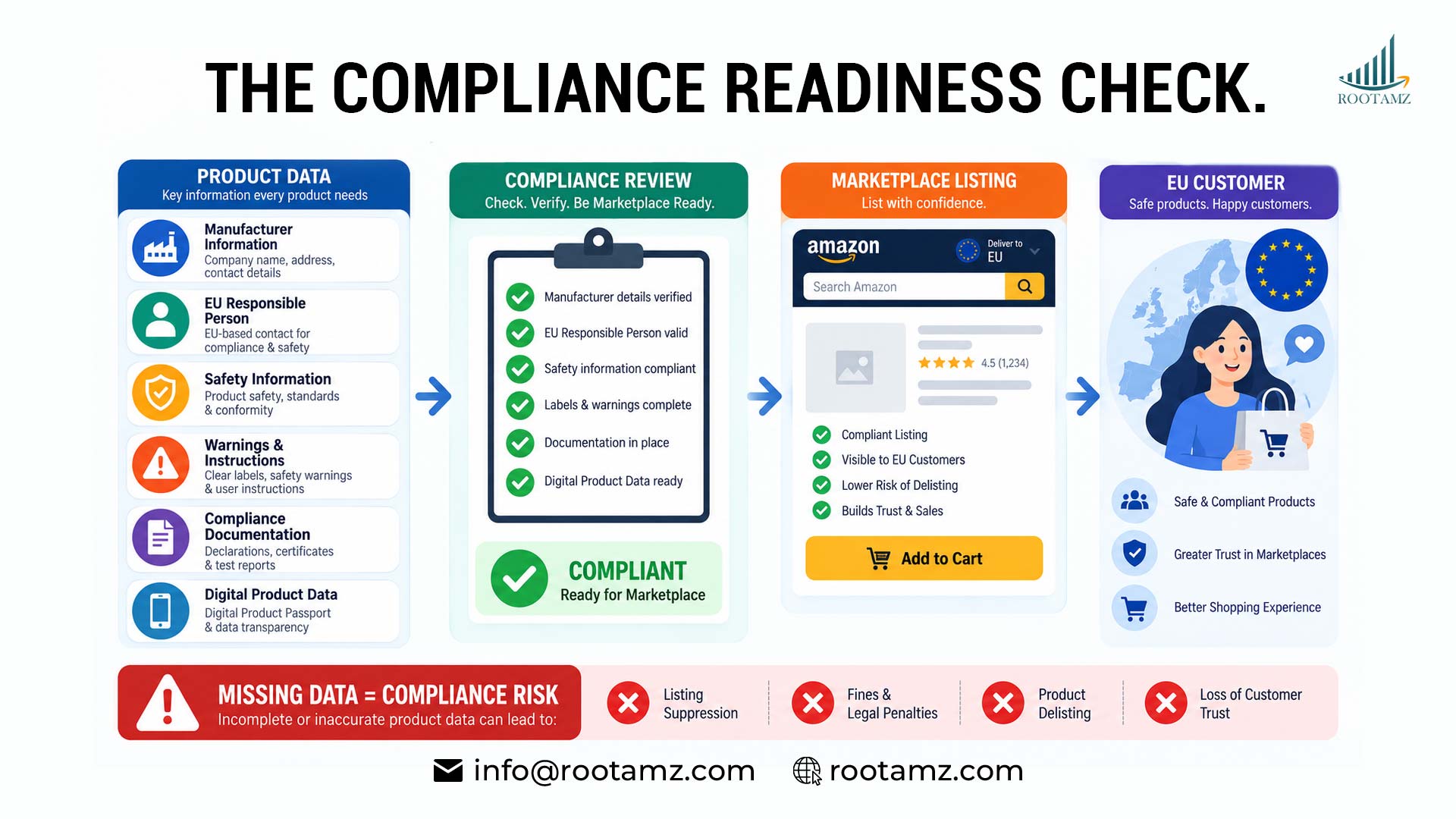
EU Responsible Person a named individual or company based in the EU who acts as your local regulatory contact. Their name and address must appear on the product or packaging. This is not optional and Amazon's systems check for it automatically.
Manufacturer details name and contact information of whoever made the product.
Safety warnings and instructions in the correct language for each EU country where you sell.
Supporting documentation technical file, risk assessment, test reports ready to produce on request.
The bit most sellers underestimate is the last one. Amazon's automated systems scan product pages for missing responsible person information. If the field is blank, the listing gets flagged sometimes removed before a human reviewer even looks at it. And if your packaging doesn't physically show the responsible person's details, that's a separate problem on top of the listing issue.
One more thing worth knowing: you need to provide this information separately for each EU marketplace, even when the underlying details are identical. Submitting once for Amazon.de doesn't automatically cover Amazon.fr.
Digital Product Passport Not Mandatory Yet, But Moving Fast
The Digital Product Passport is the other framework sellers need to understand in 2026 even if they don't need to act on it immediately.
The DPP is being developed under the EU's Ecodesign for Sustainable Products Regulation. The idea is simple: every covered product will eventually carry a digital record of its key information materials, sustainability data, manufacturing details, repair instructions, compliance documentation accessible via a QR code or similar data carrier.
The EU's DPP Registry went live on 20 July 2026. The infrastructure is now operational. But here's the important distinction: DPP requirements are rolling out category by category, not all at once.
The first mandatory deadline is 18 February 2027 for certain battery types. After that, textiles, furniture, electronics, tyres, and other categories follow on their own timelines. If your product sits in one of these categories, 2026 is the preparation window not the deadline year, but the year to get your product data in order before it becomes a compliance requirement.
The Real Problem Is Usually the Data
Here's what actually causes most EU compliance headaches for marketplace sellers. It's not a lack of documentation. It's that the documentation exists in five different places with five slightly different versions of the same information.
Your ERP has one product name. Your supplier spreadsheet has another. Your packaging was updated six months ago but your Amazon listing wasn't. The responsible person address changed when you switched service providers but only got updated on two of your four EU stores.
That kind of inconsistency across manufacturers, model numbers, safety warnings, responsible person details is exactly what marketplace compliance checks are designed to catch. And when Amazon's automated systems find it, the result is a flagged listing, a compliance request with a tight deadline, and a scramble through folders that should have been organised months ago.
The businesses handling EU compliance well in 2026 aren't necessarily doing anything complicated. They've built a central compliance master file one record per SKU that maps the manufacturer, responsible person, safety documentation, and marketplace status. When Amazon asks for something, the answer takes minutes, not days.
How RootAMZ Helps You Stay Ahead of This
EU compliance and Amazon catalogue management are the same problem from two different angles. A listing that's beautifully optimised strong title, great images, A+ Content, active PPC becomes worthless the moment it's deactivated for a missing responsible person field.
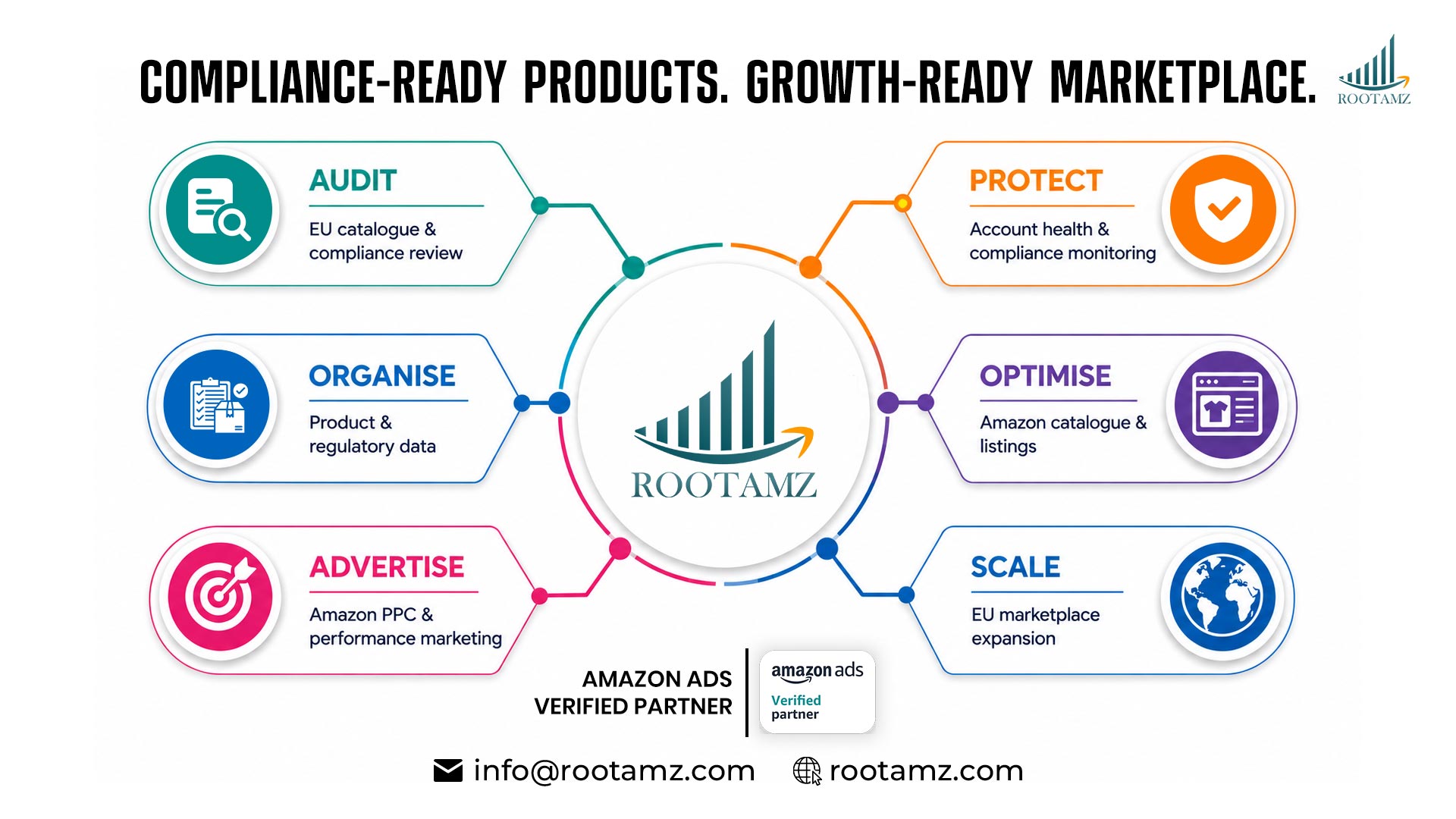
RootAMZ's Amazon Seller Central Management takes an integrated approach connecting compliance, catalogue, account health, and advertising so they work together rather than creating problems for each other.
Services RootAMZ Provides:
Amazon EU Compliance Support catalogue audits, compliance gap identification, and documentation workflow coordination across EU marketplaces.
Amazon Seller Central Management proactive account health monitoring across all EU stores including compliance status tracking.
Amazon Listing Optimisation listings built with EU compliance fields correctly populated, not retrofitted after a flag.
Amazon PPC Management advertising strategy aligned with product availability, so spend isn't wasted driving traffic to at-risk listings.
Amazon A+ and Premium A+ Content EU-localised brand content built for German, French, Italian, and Spanish marketplaces.
Multi-Marketplace Management consistent compliance and catalogue standards across Amazon, Walmart, and eBay simultaneously.
Whether you're managing ten SKUs or a thousand, RootAMZ brings the operational structure to keep your EU catalogue compliant and your listings live. And as an Amazon Ads Verified Partner, our advertising capabilities connect compliance-ready products with a performance-focused advertising strategy — so the moment your listings are protected, they're also working harder for your business.
Protect your listings. Prepare your products. Build for EU growth.
Talk to RootAMZ today. Get in touch before Amazon does it for you.
FAQ's
What is GPSR & when did it become applicable?
The General Product Safety Regulation or GPSR, is the EU framework governing general product safety for covered products, including products sold online. It became applicable on 13 December 2024.
What information does Amazon require for GPSR compliance?
For affected products, Amazon's guidance includes information such as the EU Responsible Person, manufacturer details & applicable warning or safety information. Amazon states that non-compliant offers may be deactivated.
Is the Digital Product Passport mandatory for every product in 2026?
No. DPP requirements are being introduced progressively by product category & legislation. The EU DPP Registry became operational in July 2026, but individual product obligations depend on the applicable rules & delegated acts.
Which products will be affected by the Digital Product Passport?
The DPP framework is being rolled out across different product groups. The EU's current planning includes areas such as batteries, textiles, tyres, furniture, ICT products, iron & steel & other categories, with specific requirements introduced at different stages.
Can RootAMZ help with Amazon EU compliance & marketplace management?
Yes. RootAMZ can support the marketplace-management side of EU compliance by helping sellers organise product data, audit catalogues, manage listing information, monitor Account Health & coordinate compliance workflows. RootAMZ also offers Amazon advertising services as an Amazon Ads Verified Partner, allowing compliance, catalog & growth strategies to work together.