Retail media used to be a side project for most eCommerce teams. That has changed. It now takes a real share of budgets at manufacturers, distributors and brands, because it offers what other ad channels rarely can: shoppers who are close to buying, and purchase data that shows what actually worked.
In the U.S., advertisers spent about $58.79 billion on retail media in 2025, according to eMarketer. Its latest forecast for 2026 is around $69.33 billion, while another forecast from earlier this year says $71.09 billion, depending on how the category is defined. The direction is the same either way.
For brands on Amazon, that raises a fair question. Is your Amazon Ads budget growing with a strategy behind it, or are you spending more just to defend the sales you already have?
Why Retail Media Is Different
Traditional advertising leans on reach, awareness and guesses about intent. Retail media sits right next to the transaction. A shopper searches, compares options, reads reviews, checks the price and availability, then buys. Amazon sits inside that entire journey.
eMarketer expects Amazon to drive most of U.S. retail media growth in 2026, and says Amazon and Walmart together should capture over 89% of the incremental spend. So Amazon advertising is no longer just a PPC line item. It is part of your eCommerce growth strategy.
The Mistake: More Budget, Same Strategy
Plenty of brands follow the same loop. Sales go up, so PPC budget goes up, sales go up again, and the budget rises once more. Eventually someone asks why profit isn't improving.
Often the budget isn't the problem. The allocation is. Common signs include:
Heavy spend on branded keywords
Too much budget protecting ASINs that already convert
No clear split between discovery and conversion campaigns
Weak product detail pages
Little investment in new-product discovery
Wasted spend on irrelevant search terms
Thin competitor or category targeting
No upper-funnel activity
Ad decisions made without checking inventory
Adding money doesn't fix any of that. Better allocation does.
Amazon Ads Is a Full-Funnel System Now
Amazon is positioning its advertising across the whole customer journey, from awareness through to conversion, with AI, streaming, creator commerce and integrated measurement all part of its 2026 trends. For a growing brand, that means campaigns can play different roles:
Discovery: introduce products to shoppers who don't know you yet.
Consideration: use video, display and audience targeting to explain benefits and what sets you apart.
Conversion: use Sponsored Products and other lower-funnel formats to catch shoppers ready to buy.
Retention: keep the brand visible and encourage repeat purchases where it makes sense.
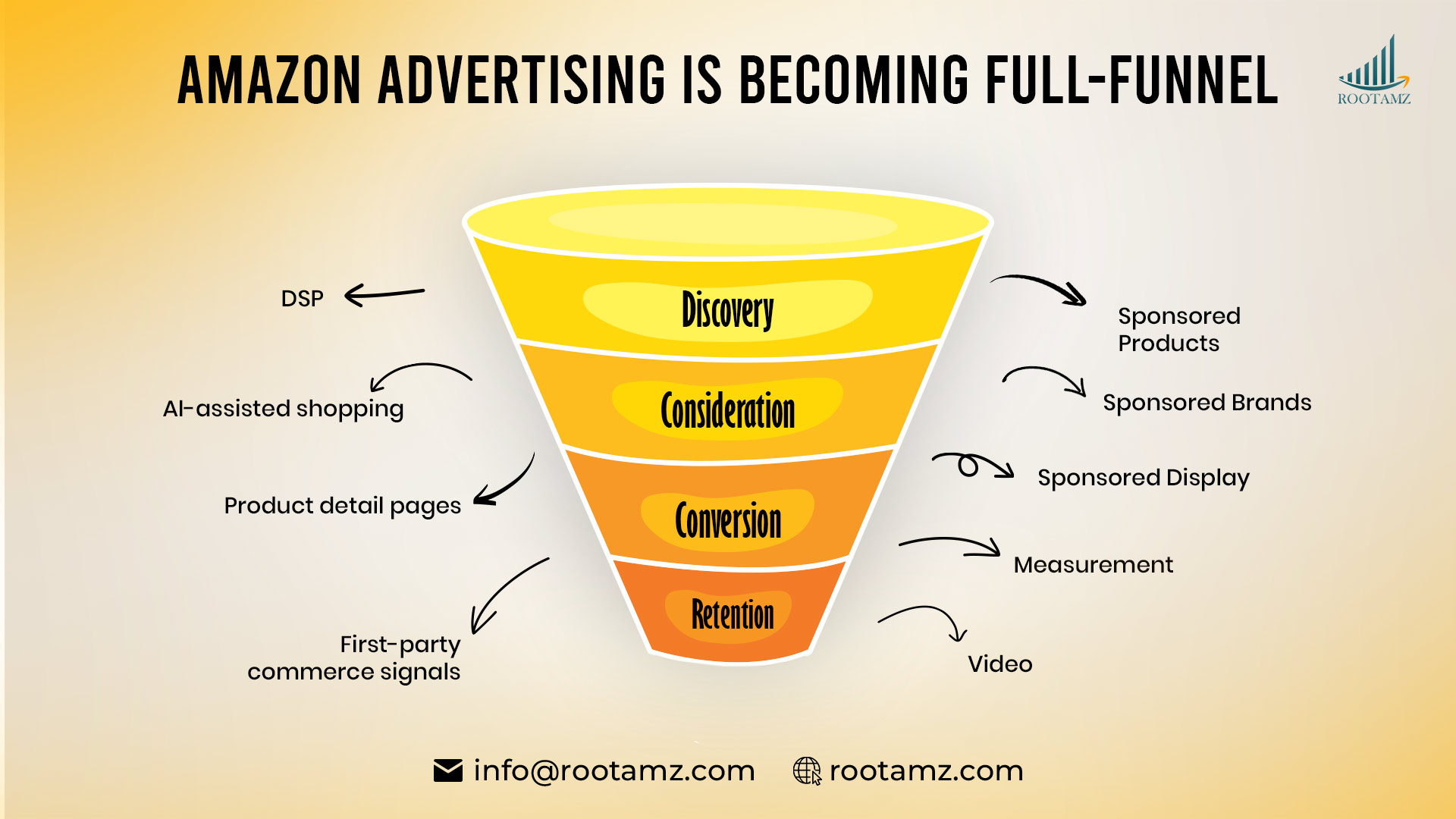
Not every campaign needs the same job. Your budget should follow the job each one is meant to do.
AI Is Changing How People Find Products
In 2026, Amazon merged Rufus and Alexa+ into one shopping experience called Alexa for Shopping. Shoppers can ask questions, get personalised guides, compare products, check price history and hunt for deals.
So the journey is getting more conversational. Instead of typing "running shoes," someone might ask which shoes suit a person who runs five kilometres three times a week. Relevance then depends on context, product information and intent. Amazon Ads also cites industry research showing AI-referred traffic to U.S. retailers grew 393 percent year over year in Q1 2026 and converted about 42 percent better than traditional search traffic.
The takeaway: your ad strategy and your product data can't live in separate boxes.
Your Product Page Is Part of the Ad Budget
Picture paying for traffic to a page with weak images, an unclear use case, missing attributes, confusing variations and no answers to common questions. You can tune the campaign all day and the page will still cap your results.
That's why ads should be tied to catalog management, listing optimisation and creative work. At RootAMZ, we look at the whole chain: advertising, product detail page, catalog, inventory, conversion and profitability. Fix one link and ignore the rest, and you just move the bottleneck.
ROAS Alone Isn't Enough
ROAS is still useful, but leadership shouldn't rely on it alone. A campaign can post a great ROAS and still miss new customers. Another may look weaker today while building discovery and future demand. The IAB points to incrementality, advanced measurement, data collaboration and clean rooms as retail media measurement matures.
Better questions to ask:
What sales is advertising directly generating?
Which campaigns find new customers?
Which ASINs get most of the investment?
Are branded campaigns eating too much budget?
Is advertising supporting product launches?
Are margins improving alongside revenue?
Are inventory limits hurting ad efficiency?
How to Review Your Budget
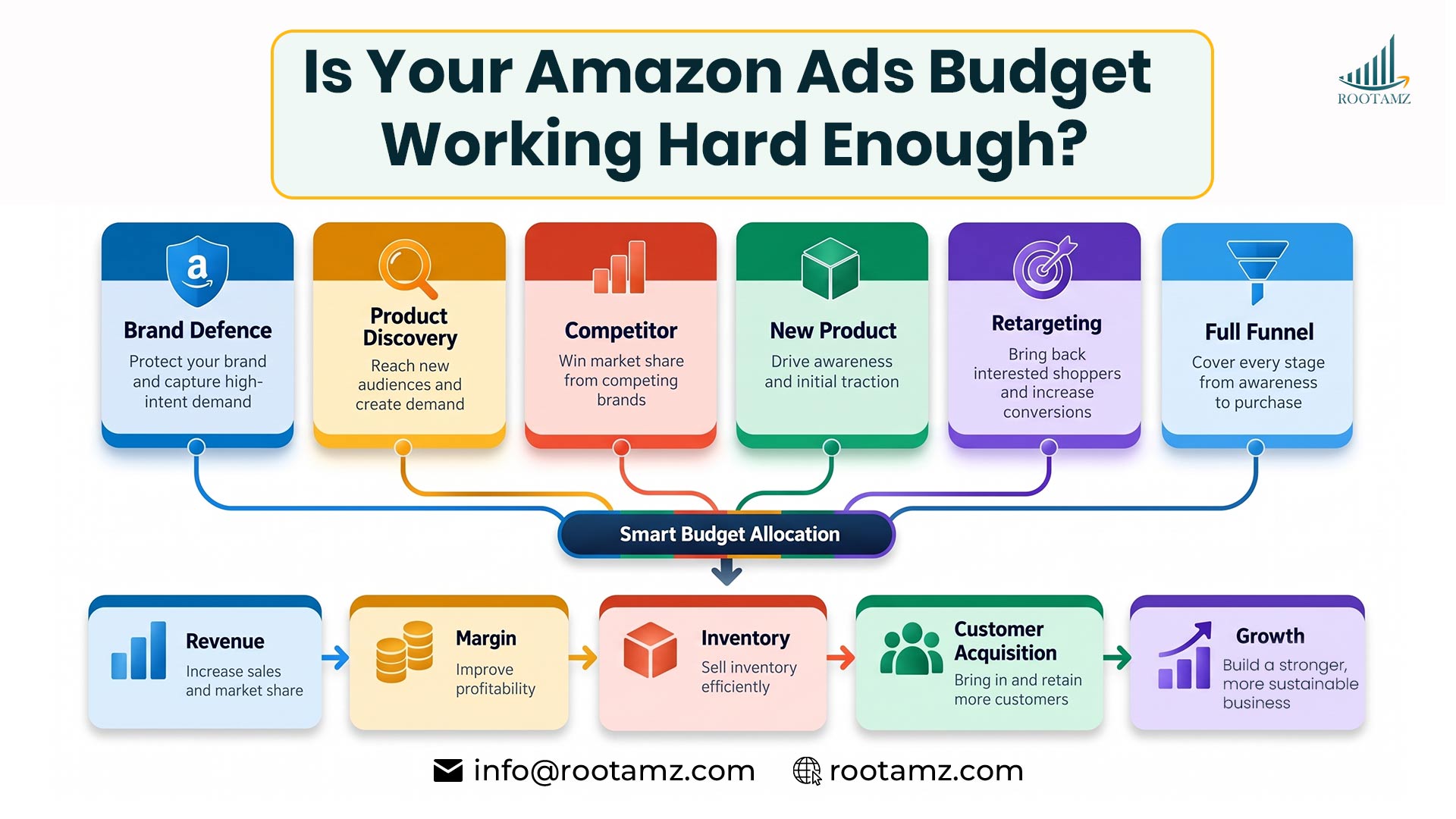
There's no single percentage every brand should spend. A manufacturer with strong distribution and organic rankings needs something different from a new DTC brand entering Amazon. Budget should reflect your goals, category competition, product lifecycle, margins and stock. A good review covers:
Revenue dependency: how much of your Amazon revenue relies on paid ads?
Profitability: are you chasing volume, contribution margin or something else?
Portfolio: which ASINs deserve more, and which need protection from needless spend?
Opportunity: are there profitable keywords, audiences, categories or marketplaces you haven't tried?
Funnel coverage: are you only capturing existing demand, or creating future demand too?
Readiness: can your inventory, catalog and pages support more spend?
Where RootAMZ Fits
We don't treat Amazon Ads as an isolated PPC task. RootAMZ supports manufacturers, brands, distributors and marketplace sellers with Sponsored Products, Sponsored Brands and Sponsored Display, Amazon DSP, campaign structure, keyword and search-term analysis, budget allocation, launch advertising, catalog and listing optimisation, A+ Content and Brand Stores, creative, marketplace expansion, inventory coordination and business-level reporting. We're also an Amazon Ads Verified Partner.
The goal isn't to help you spend more. It's to show where ad investment can build sustainable growth, and where spending may be hiding an operational problem.
Final Thoughts
Retail media will keep growing. The real question isn't whether to raise your Amazon Ads budget, but whether your whole Amazon growth system can make better use of every dollar. Don't just add budget. Build a plan that protects visibility, improves efficiency and scales profitably.
Want to know if your budget is keeping pace? Reach out to the RootAMZ team for a professional Amazon Ads review and a more structured path to profitable marketplace growth.
FAQ's
Is retail media really a $58 billion category?
Yes. The $58B+ figure refers to U.S. retail media advertising spending in 2025. eMarketer estimated $58.79 billion for 2025 & has since forecast approximately $69.33 billion for 2026, while another forecast puts 2026 spending at $71.09 billion.Your question here?
Should every Amazon seller increase their advertising budget?
No. Advertising budgets should be based on factors such as product margins, inventory, category competition, business objectives, organic performance & product lifecycle. Increasing spend without addressing conversion or operational problems can reduce efficiency.
Is Amazon Ads still mainly about Sponsored Products?
Sponsored Products remain an important part of Amazon advertising, but the ecosystem is much broader. Brands can consider Sponsored Brands, Sponsored Display, video, DSP & full-funnel opportunities depending on objectives & eligibility.Your question here?
How is AI changing Amazon advertising?
AI is increasingly influencing both advertising execution & shopping behaviour. Amazon's 2026 developments include AI-assisted shopping experiences such as Alexa for Shopping & expanded AI-powered advertising tools.
Can RootAMZ manage Amazon Ads as well as the wider eCommerce operation?
Yes. RootAMZ supports brands, manufacturers, distributors & marketplace sellers across Amazon advertising, catalog management, listing optimisation, creative, marketplace operations & broader eCommerce growth. RootAMZ is an Amazon Ads Verified Partner, allowing brands to combine advertising expertise with wider marketplace account management support.