Amazon Keyword Research in 2026: Tools, Tactics & Mistakes That Cost Sellers Rankings
Let’s be straight about something Amazon keyword research on Amazon in 2026 looks nothing like it did three years ago. The sellers who are still copying competitor titles and stuffing backend fields with broad match terms are quietly watching their organic rankings slip, and most of them don’t know why. The platform has changed. The algorithm has changed. And the gap between sellers who understand that and those who don’t is getting wider every quarter.
At RootAMZ, an Amazon Ads Verified Partner we run keyword audits and listing optimisation for brands on Amazon, Walmart, and eBay every single week. Our team comes directly from inside Amazon Vendor Central, Seller Central, Catalog, Account Health so we see the consequences of bad keyword strategy up close.
What Has Actually Changed in 2026
Amazon’s A10 algorithm now reads purchase intent signals far more aggressively than it used to. A keyword that pulls strong impressions but weak conversions does not just underperform, it actively works against you. The system interprets low conversion on a search term as a relevance mismatch and starts dialling back your exposure for that term. RootAMZ analysts see this pattern repeatedly when onboarding new clients: listings chasing head terms they cannot convert on, dragging down the organic rank for terms they could actually own.
Session quality and click-through-to-purchase velocity now carry more weight than raw keyword frequency. This shifts the entire strategic frame. Instead of asking “how many places can I fit this keyword,” the better question is “which keywords does my listing actually convert on?” RootAMZ builds every listing strategy around that second question.
Tools Worth Using and How RootAMZ Stacks Them
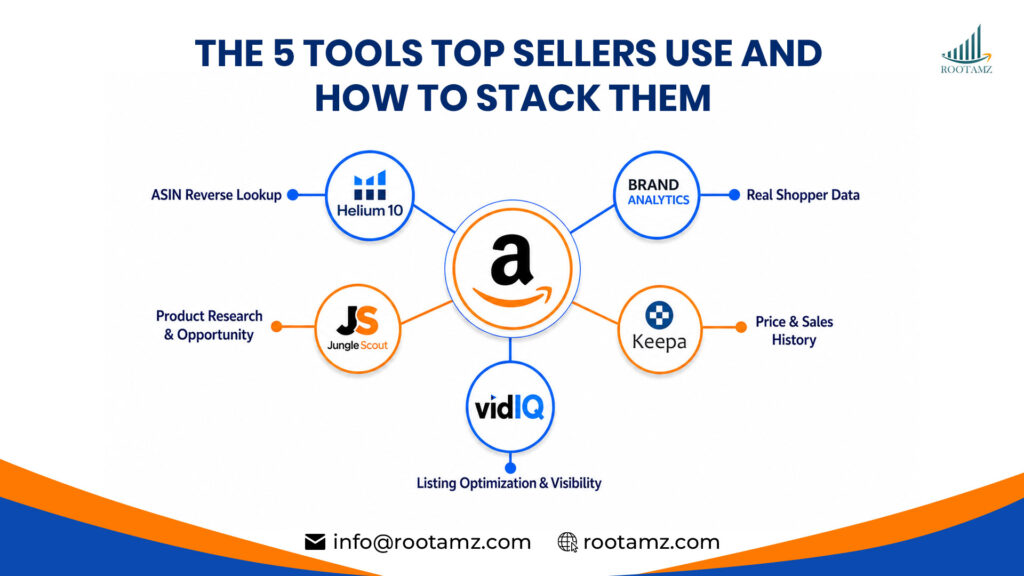
No single tool covers everything. RootAMZ uses a layered approach that combines first-party Amazon data with third-party intelligence:
- Amazon Brand Analytics (ABA): The Search Frequency Rank data here is sourced directly from Amazon shopper behaviour. It is the most reliable signal available to Brand Registry sellers and the starting point for every RootAMZ keyword map.
- Helium 10 Cerebro: Reverse ASIN lookup that shows you exactly which terms your competitors are ranking for organically. RootAMZ runs Cerebro on the top 5 competitors in every niche during client onboarding to find gaps worth targeting.
- Sponsored Products Search Term Reports: Sellers overlook this constantly. Your own ad account already contains real conversion data by search term. RootAMZ mines these reports monthly to surface organic keyword opportunities hiding in paid campaign history.
- DataDive: Strong for long-tail discovery and indexing verification across multiple ASINs. Useful for building out backend search terms with non-obvious synonyms and category-specific language.
- Jungle Scout Keyword Scout: Particularly helpful for seasonal trend mapping. RootAMZ factors seasonal keyword curves into quarterly listing refresh schedules for clients in weather-sensitive or gifting categories.
Tactics That Still Deliver Results
The fundamentals haven’t disappeared-they’ve just become more precise. RootAMZ applies these consistently across Amazon Seller Central and Amazon Vendor Central accounts:
- Lead your title with the primary intent keyword in the first 80 characters. Brand name and secondary descriptors come after. RootAMZ structures titles around buyer language first, not internal product naming.
- Use backend search terms for what visible copy cannot hold competitor misspellings, Spanish-language variants, older product names that buyers still search. RootAMZ fills all 250 bytes with non-repeated, non-indexed terms only.
- Amazon A+ Content now indexes text within modules. RootAMZ’s content team treats A+ pages as structured keyword real estate for secondary and long-tail terms that feel forced inside bullet points.
- Before committing a keyword to organic copy, RootAMZ runs it as an exact-match sponsored keyword for two to three weeks. Only terms that demonstrate real conversion potential get promoted into the listing itself.
Mistakes That Quietly Kill Your Rankings
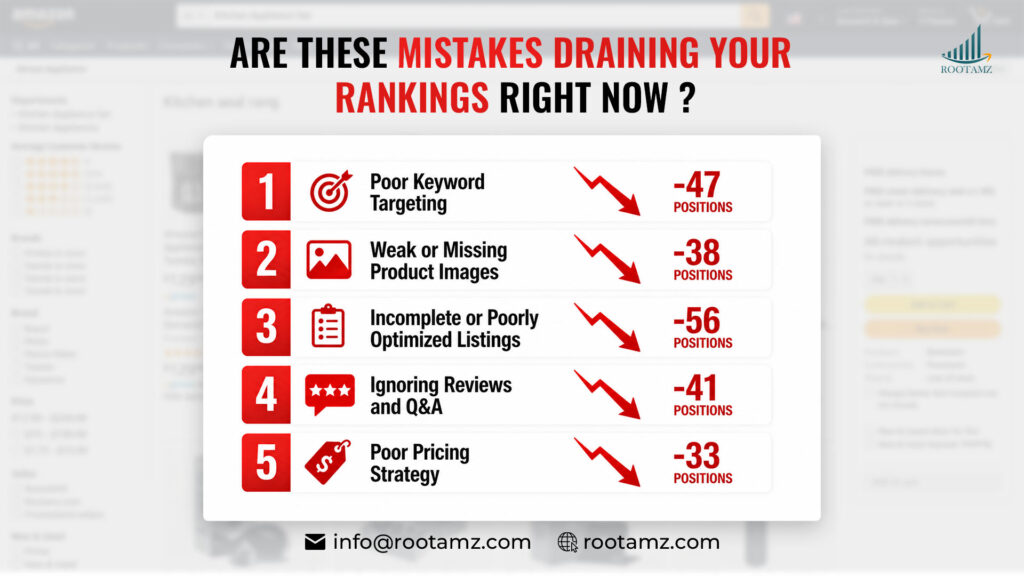
These show up in almost every account audit RootAMZ conducts and they are more common among experienced sellers than beginners, because they build up gradually:
- Keyword cannibalism across variations: when your parent and child ASINs all chase the same primary term, they compete against each other, fragmenting conversion data and weakening every ASIN in the group. RootAMZ differentiates keyword focus intentionally by variation.
- Ignoring negative keywords in PPC: irrelevant clicks bleed ad spend and send a poor relevance signal back to the algorithm. RootAMZ treats negative keyword harvesting as one of the highest-ROI activities in any sponsored campaign.
- Choosing keywords by volume alone: a term with 80,000 monthly searches and a 0.4% conversion rate does more damage than one with 6,000 searches and a 3.5% conversion rate. RootAMZ weights keywords by conversion potential, not search volume rank.
- Never refreshing backend terms: buyer language shifts, new terms trend, and category vocabulary evolves. RootAMZ schedules backend keyword audits quarterly for all managed accounts not once at launch.
Where Keyword Research Fits Inside a Full Growth Strategy
Keyword research is one part of a connected system. RootAMZ takes care of Amazon Seller Central and Vendor Central accounts from start to finish. This includes everything from
- PPC advertising
- A+ Content & Premium A+ Content
- Amazon Brand Stores Design
- Product listings optimising
- Amazon account health management
- Amazon Vendor central Management
Overseeing inventory, and providing multi-channel support on platforms like Walmart and eBay. If you want rankings that hold, the work has to connect across every layer of your listing and that is exactly what RootAMZ is built to do.
✅ Turn Smarter Keyword Strategies into Higher Amazon Sales in 2026
FAQ’S
Is Amazon Brand Analytics more reliable than third-party tools?
Yes, ABA pulls directly from real Amazon shopper searches, making it the most accurate source available.
What is keyword cannibalism and why does it matter?
When multiple ASINs in your catalog target the same primary keyword, they split conversion signals and weaken each other's rankings.
Can the same keyword strategy work across Amazon and Walmart?
No, Walmart's search algorithm weighs item attributes and relevance signals differently than Amazon's A10.
How does RootAMZ handle keyword research for a brand new product launch?
RootAMZ builds a launch keyword map using Brand Analytics data, competitor ASIN reverse lookups via Helium 10, and a short exact-match PPC test to confirm conversion intent before any keyword gets committed to the organic listing copy