Amazon EDI Compliance 2026 for Vendors: Key Changes & How to Avoid Costly Rejections
Let’s be honest, most vendors don’t think about their EDI setup until something breaks. A chargeback lands, a shipment gets flagged, or a payment gets short-paid, and suddenly Amazon EDI compliance goes from a back-office task to a very urgent problem. At RootAMZ, we deal with the aftermath of this every week. The good news? Almost every rejection and chargeback we see is preventable, if you know what changed and where the gaps typically show up.
What Exactly Is Amazon EDI, and Why Is 2026 Different?
Amazon EDI is basically how your systems talk to Amazon’s systems without anyone typing anything manually.
What makes 2026 different is that Amazon made two rule changes. One happened in July 2025. Then another in January 2026. These changes were not really made public. Vendors who hadn’t touched their integration settings in a year started seeing chargebacks appear seemingly out of nowhere. RootAMZ clients who had proactive monitoring in place? They caught the gaps before Amazon did. That’s the difference. As an Amazon Ads Verified Partner, RootAMZ closely monitors these shifts for compliance impact
The main documents for Amazon EDI compliance in 2026 are the 850 which’s a Purchase Order, the 855 which is a PO Acknowledgment, the 856 which is an Advance Ship Notice and the 810 which is an Invoice.
5 Key Changes Amazon Vendors Need to Act On
1. Direct Fulfilment now runs through SP-API, not traditional EDI
This is the biggest structural shift. Any new Direct Fulfilment onboarding in 2026 has to go through Amazon’s Selling Partner API. Existing EDI connections still work, Amazon isn’t pulling the plug on those-but if you’re setting up a new drop ship arrangement, your tech stack needs API capability from the start.
2. ASN timing got tighter and the window is smaller than you think
Your EDI 856 (Advance Ship Notice) needs to go out when the shipment is staged and ready for pickup not when the truck actually leaves. That’s a meaningful difference. A lag of even a few hours can trigger a chargeback. RootAMZ builds ASN workflows with warehouse teams specifically to catch this, because it’s one of the nastiest recurring issues we see in vendor audits.
3. Invoice-to-PO matching is now enforced at the line-item level
Your EDI 810 invoice has to match the original PO and ASN quantities exactly. One unit off on one SKU is enough to create a flag. For vendors with large catalogs, doing this manually is a recipe for constant discrepancies. Automation isn’t optional here anymore, it’s the only reliable path to Amazon EDI compliance.
4. AS2 is still Amazon’s preferred transmission protocol
If you’re running SFTP or a VAN as your primary channel, you’re not technically in violation but you’re working with a less stable setup. AS2 offers better error recovery and faster transmission confirmation.
5. Your Vendor Central compliance scores now actually matter
Amazon surfaces these metrics on the dashboard, and they feed into trade term conversations and account standing reviews. Brands that check these weekly spot problems early. Brands that don’t check them at all usually find out through a nasty surprise. RootAMZ monitors these for all Vendor Central accounts we manage, it’s built into the weekly workflow, not an afterthought.
The Most Common EDI Rejections
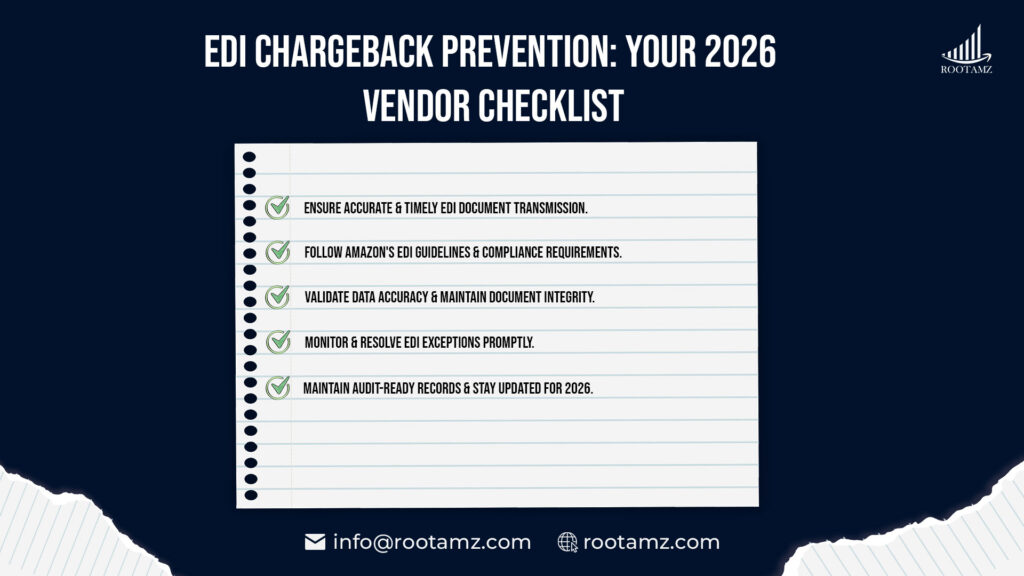
Based on what RootAMZ sees across vendor account audits, the same four problems show up again and again: late or missing ASNs, invoice quantity mismatches, outdated product identifiers in PO acknowledgments, and routing requests that don’t reflect Amazon’s current fulfillment center network.
How RootAMZ Handles Amazon EDI Compliance and Everything Around It
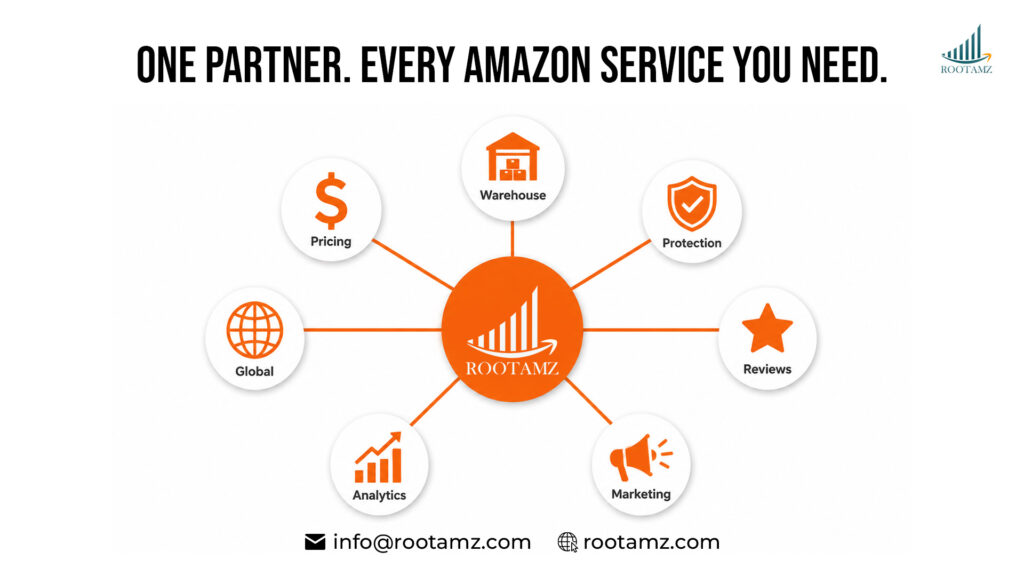
RootAMZ is a full-service Amazon and eCommerce marketplace management company,On the Amazon EDI compliance side specifically, RootAMZ manages PO tracking, ASN coordination, chargeback recovery, and shortage claim handling. We use automation to eliminate the manual touchpoints where errors happen. Beyond EDI, here’s what RootAMZ also handles for vendor and seller clients:
Amazon Vendor Central Management: Catalog work, content compliance, pricing strategy, trade terms, and daily operational support across NA and EU accounts.
Chargeback and Shortage Recovery: RootAMZ do this by filing disputes with all the papers, like Bills of Lading and shipment photos.
Amazon Seller Central Management: Listing optimization, PPC, inventory management, and account health monitoring.
Amazon Ads and PPC: Ad strategies built around lowering ACoS and increasing return across Amazon, Walmart, and eBay.
A+ Content and Brand Store Design: Premium A+ pages and Brand Store builds that actually convert, not just look good.
Multi-Marketplace Expansion: RootAMZ handles compliance, localization, and VAT so scaling internationally doesn’t become a compliance nightmare.
Brand Registry and Protection: Hijacker removal, unauthorized reseller enforcement, and Brand Registry setup to protect pricing integrity.
Whether recurring chargebacks are eating into margins, EDI rejections Vendor Central account is just taking too much internal bandwidth, RootAMZ is set up to handle all of it under one roof.
Final Thoughts
Amazon EDI compliance isn’t going to get looser-if anything, Amazon keeps adding more automation to its enforcement, which means more automatic deductions for vendors who aren’t keeping up. The vendors who handle this well aren’t necessarily bigger or better resourced. They just have the right processes and the right team watching it. RootAMZ exists to be that team.
✅ Reach out to learn more about how RootAMZ helps Amazon vendors with EDI compliance, chargeback recovery, Vendor Central management
FAQ’s
Does Amazon's shift to SP-API mean my current EDI Direct Fulfilment setup stops working?
No, existing EDI-based Direct Fulfilment connections keep running, but all new onboarding from 2026 onward must use SP-API instead of traditional EDI.
Exactly when does the ASN need to be sent to stay compliant?
It needs to transmit when the shipment is staged and ready for carrier pickup submitting after the carrier has already collected the goods is too late and risks a chargeback.
We have an EDI setup running but still keep getting chargebacks — what's usually wrong?
Most of the time it's stale routing configurations, data mapping mismatches, or ASN timing gaps a targeted EDI audit typically identifies the exact trigger within the first review.
Can RootAMZ manage our Amazon EDI compliance alongside the rest of our Vendor Central account?
Yes, RootAMZ's Vendor Central service includes EDI compliance monitoring, ASN coordination, PO tracking, chargeback recovery, and shortage claim handling as part of one integrated engagement.