If you’re running ads on Amazon & focusing only on adding new keywords, you’re optimising only half the equation.
The other half & often the most profitable half, is mastering negative keywords.
In highly competitive categories, profitability isn’t just about increasing traffic. It’s about eliminating waste.
At RootAMZ, we’ve audited hundreds of Amazon ad accounts. The most common issue we see?
Sellers spending aggressively on irrelevant search terms.
Poor ROAS due to unfiltered traffic.
No structured negative keyword strategy.
This guide will show you how to use Amazon PPC negative keywords strategically & how RootAMZ builds scalable, profit-focused ad systems.
What Are Negative Keywords in Amazon PPC?
Negative keywords prevent your ads from appearing for specific search terms.
Instead of telling Amazon when to show your ads, you’re telling Amazon when not to show them.
Example:
If you sell “premium leather office chairs”, you may want to exclude:
- cheap office chair
- plastic chair
- gaming chair under $50
Without negative keywords, your budget gets consumed by low-intent or irrelevant traffic.
Also, wasted traffic = wasted ad spend
Why Negative Keywords Are Critical for Profitability
Most sellers obsess over:
- Increasing impressions
- Scaling bids
- Expanding keyword lists
But rarely focus on:
- Reducing wasted clicks
- Filtering irrelevant traffic
- Improving conversion rate quality
Negative keywords help:
- Improve ROAS
- Increase CTR
- Boost conversion rates
- Reduce ACoS
- Strengthen campaign efficiency
Optimization is not about spending more.
It’s about refining smarter.
Types of Negative Keywords on Amazon
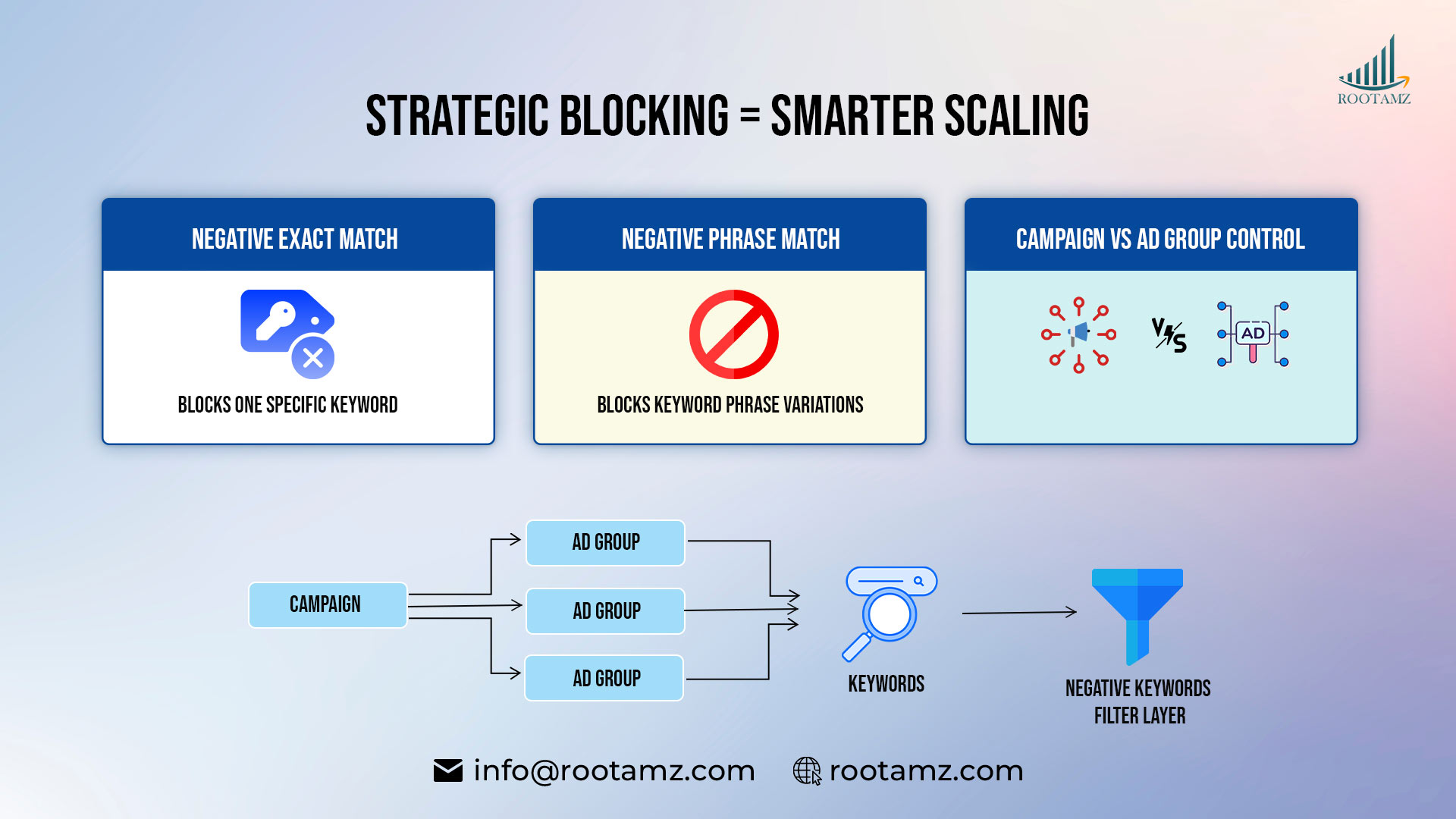
Amazon allows two primary negative match types:
Negative Phrase Match
Blocks ads when the exact phrase appears in a search query.
Example:
Negative phrase: “cheap chair”
Your ad won’t show for:
- cheap office chair
- best cheap chair
Negative Exact Match
Blocks ads only when the exact search term matches.
Example:
Negative exact: “cheap chair”
Your ad won’t show for:
- cheap chair
But may still show for: - cheap office chair
Choosing between phrase & exact depends on traffic behaviour analysis.
At RootAMZ, we structure negative filtering based on performance data, not assumptions.
Where to Find Negative Keyword Opportunities
A strong Amazon Advertising Strategy starts with understanding your Search Term Report.
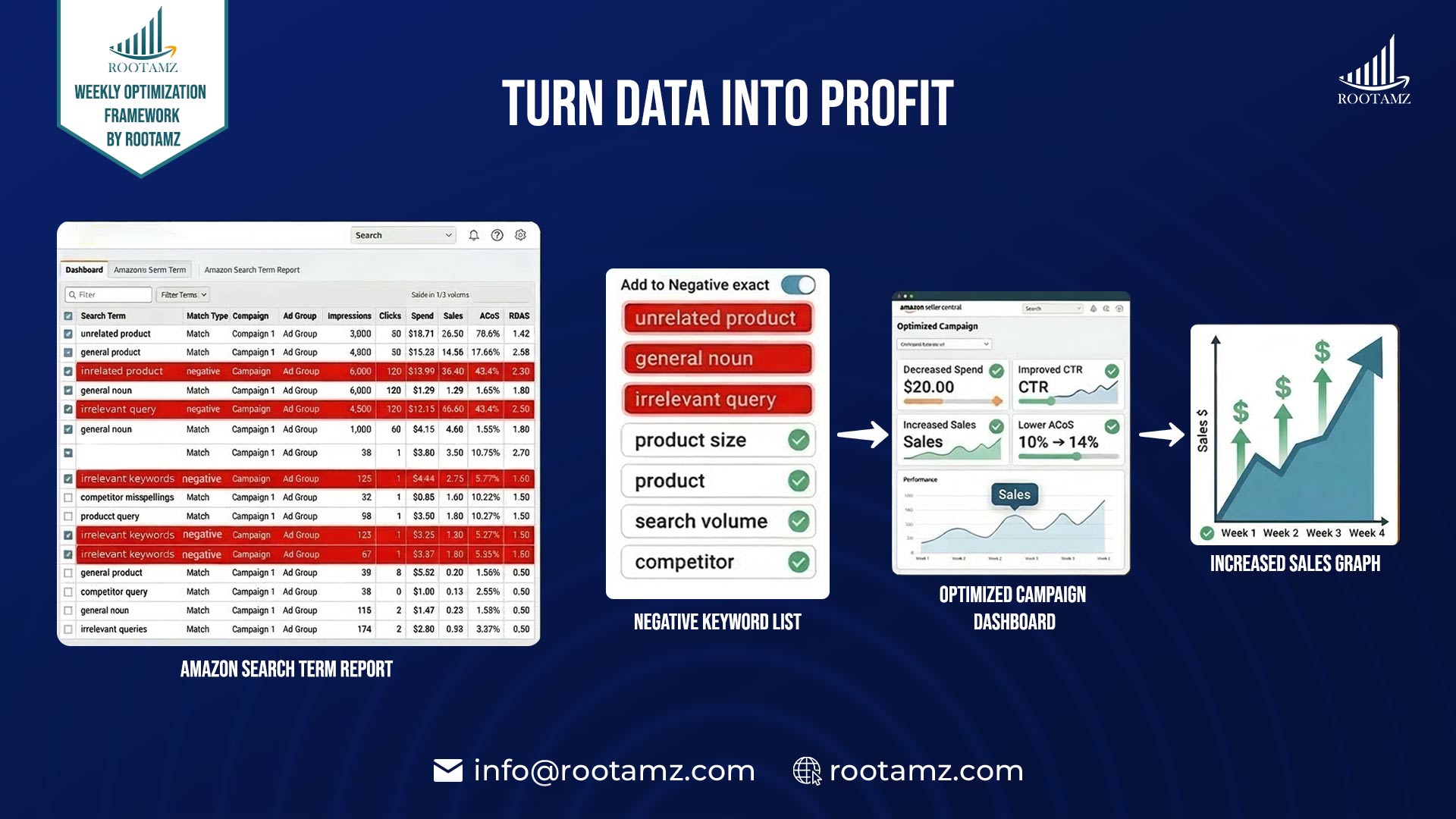
The goldmine lies in your Search Term Report. Inside your advertising console, analyse:
- High-spend, zero-sale search terms
- Low conversion rate terms
- Irrelevant variations
- Competitor mismatch queries
This report reveals where your money is leaking. Many sellers download the report… but never properly analyse it. That’s where structured PPC management makes the difference.
Step-by-Step Negative Keyword Optimisation Framework
Here is the RootAMZ approach:
1. Analyse Search Term Data (Weekly)
We review:
- Spend per search term
- Conversion rate
- Cost per click
- Sales contribution
If a keyword spends significantly without conversions, it becomes a negative candidate.
2. Segment by Campaign Type
Negative strategy differs across:
- Automatic campaigns
- Manual campaigns
- Broad match
- Phrase match
- Exact match
For example:
- Auto campaigns are discovery engines
- Manual campaigns are scaling engines
We add negatives in auto campaigns to funnel traffic into controlled manual campaigns.
3. Identify Intent Mismatch
Sometimes a keyword converts, but not profitably.
Example:
If you sell premium products & traffic is coming from “cheap” searches, it may convert poorly despite impressions.
Intent filtering improves long-term profitability.
4. Protect High-Intent Campaigns
Another advanced strategy:
Block broad traffic from interfering with exact campaigns.
We use negative keywords to:
- Prevent keyword cannibalization
- Control search query routing
- Protect high-converting terms
This creates campaign hierarchy & bidding efficiency.
Common Negative Keyword Mistakes
Many sellers make these costly errors:
- Adding too many negatives too quickly
- Blocking keywords without enough data
- Using only exact match negatives
- Ignoring auto campaign reports
- Failing to update weekly
Negative keywords should be data-driven, not emotional reactions to a few clicks.
How Negative Keywords Improve Organic Ranking
When you eliminate irrelevant traffic:
- Your conversion rate increases
- Sales velocity improves
- Keyword performance strengthens
Amazon’s algorithm rewards high-converting listings.
Cleaner traffic = stronger algorithm signals.
This is why structured PPC impacts organic growth.
Negative Keywords & Budget Allocation
One of the biggest advantages of proper negative filtering:
You redirect wasted spend into high-performing keywords.
Instead of increasing budget blindly, you:
- Reduce ad waste
- Improve ROI
- Scale profitable campaigns
Efficiency is scalability.
At RootAMZ, we often improve client ROAS by 20–40% simply through negative optimization & structural cleanup.
Why Most Sellers Struggle With PPC Optimisation
Running ads is easy.
Optimizing profitably is complex.
Sellers struggle because:
- No weekly optimization process
- No structured search term analysis
- Poor campaign architecture
- Lack of keyword funnel strategy
- No integration between SEO & PPC
Advertising without strategy becomes an expense.
Advertising with structure becomes an investment.
The RootAMZ PPC Optimisation System
At RootAMZ, our Amazon PPC Management Services go far beyond simply adding negative keywords. We build structured advertising ecosystems designed to maximise efficiency, improve ROAS, and scale profitable growth.
Our system includes:
• Account Audit & Structural Cleanup
• Keyword Funnel Mapping
• Search Term Analysis Framework
• Negative Keyword Segmentation Strategy
• Bid & Budget Reallocation
• Performance Reporting Dashboard
• Cross-Marketplace Advertising Integration
We integrate:
• Listing SEO
• A+ Content
• Creative optimization
• Inventory forecasting
• Marketplace expansion
Because PPC performance is connected to the entire ecosystem.
When Should You Add Negative Keywords?
Add negatives when:
- Spend exceeds profitability threshold
- Conversion rate is significantly below average
- Search term shows intent mismatch
- Cannibalization occurs across campaigns
- Testing phase is complete
Data first. Decision second.
Final Thoughts: Optimisation Is Subtraction
Most sellers believe growth means adding more:
- More keywords
- More bids
- More budget
But real profitability comes from removing waste.
Negative keywords are not a small tactic. They are a core profitability strategy.
If your Amazon PPC campaigns feel expensive, unpredictable, or inefficient, the problem may not be traffic volume.
It may be traffic quality.
At RootAMZ, we specialise in transforming chaotic ad accounts into structured, profit-driven systems.
Ready to reduce ad waste & scale smarter?
Connect with the RootAMZ team for a customized Amazon PPC optimization consultation.
FAQ’s
What are negative keywords in Amazon PPC?
Negative keywords prevent your ads from appearing for specific irrelevant search terms, helping reduce wasted ad spend.
How often should I update negative keywords?
Ideally, search term reports should be analysed weekly, especially in high-volume campaigns.
Can adding too many negative keywords hurt performance?
Yes. Over-filtering can limit reach & reduce potential sales. Optimization should always be data-driven.
Do negative keywords improve ROAS?
Yes. By eliminating unprofitable traffic, your return on ad spend typically improves significantly.
Should beginners manage negative keywords themselves?
While beginners can start with basic filtering, advanced optimization requires structured campaign architecture & consistent performance analysis.