Introduction: Why Your PPC Strategy Needs a Fresh Look in 2026
The eCommerce landscape shifts quickly & what worked for your Amazon PPC campaigns last year might be draining your budget today. As we enter 2026, marketplace competition has intensified, consumer behaviour has evolved & Amazon’s advertising platform has introduced new features that demand your attention.
Without proper PPC tools & ads management, brands face declining ROAS, wasted ad spend on underperforming keywords & missed opportunities to capitalise on high-intent traffic. Many businesses discover too late that their campaigns have been running on autopilot with outdated targeting, inefficient bid strategies, or product listings that no longer convert.
RootAMZ, as an Amazon Ads Verified Partner, brings certified expertise & proven methodologies to every Amazon PPC audit 2026 & campaign management engagement. Our comprehensive services include Amazon PPC management, Google Ads optimisation, marketplace advertising, keyword research, bid strategy development, & performance analytics all designed to maximise your return on advertising spend.This guide walks through the 10 critical elements every brand should examine in their Amazon PPC audit 2026 at the start of 2026, helping you optimise performance, reduce wasted spend & build a foundation for scalable growth.
What Are PPC Tools & Ads in the Amazon Ecosystem?
Amazon PPC Audit 2026 (Pay-Per-Click) advertising on Amazon allows brands to bid on keywords & placements, paying only when shoppers click their ads. Unlike organic rankings that develop over time, PPC tools & ads deliver immediate visibility in search results, product pages & off-Amazon placements.
Modern PPC management services leverage sophisticated tools that go far beyond basic campaign setup. These platforms analyse competitor activity, automate bid adjustments based on performance data, identify negative keywords that waste budget & provide granular reporting on campaign profitability.
Amazon’s advertising ecosystem includes Sponsored Products (keyword-targeted ads appearing in search results), Sponsored Brands (banner-style ads featuring your brand logo), Sponsored Display (retargeting & interest-based ads) & DSP (programmatic display advertising across Amazon properties & external websites).
Effective PPC management requires balancing multiple objectives: maximising visibility for high-converting keywords, controlling advertising cost of sale (ACoS), expanding market share against competitors & maintaining profitability across your product catalogue. Without proper paid advertising tools, this becomes overwhelming as campaigns scale.
Why Businesses Choose RootAMZ for PPC Advertising
RootAMZ approaches Amazon PPC audit 2026 with a strategy-first methodology that prioritises sustainable growth over vanity metrics. Whilst many agencies focus solely on increasing traffic, RootAMZ builds campaigns around your specific business objectives whether that’s launching new products, defending market share, or improving overall profitability.
The data-driven optimisation process begins with comprehensive account analysis, identifying what’s working, what’s haemorrhaging budget & where untapped opportunities exist. Rather than making assumptions, RootAMZ examines actual performance data to inform every strategic decision, from keyword selection to bid adjustments.
ROI-focused campaign management means scrutinising performance at the product level, not just the campaign level. Some products justify aggressive advertising spend to build market position, whilst others need conservative budgets to maintain profitability. RootAMZ tailors strategies to each product’s lifecycle stage & margin structure.
Transparency forms the foundation of the RootAMZ approach. Clients receive detailed reporting that clearly shows how advertising spend translates to revenue, which campaigns drive profitable growth & where budget reallocation could improve results. This clarity allows brands to make informed decisions about scaling investment.
RootAMZ PPC Services Breakdown
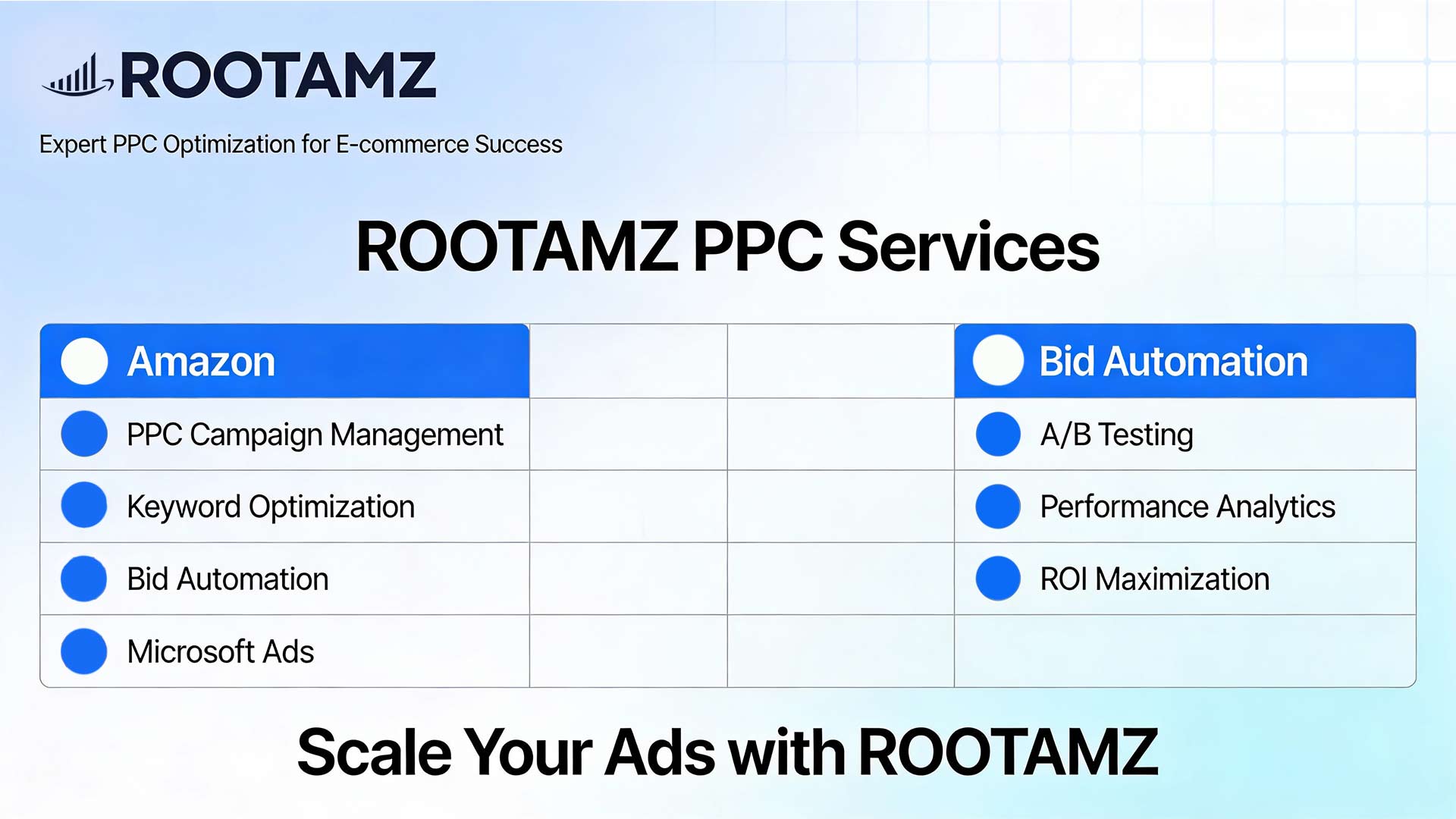
Google Ads Management
Whilst this guide focuses on Amazon, many eCommerce brands also require Google Ads optimisation to capture customers earlier in the purchase journey. RootAMZ manages Shopping campaigns, Search ads & Display remarketing that drive traffic to your website or Amazon storefront, creating a cohesive cross-channel strategy.
Amazon PPC Specialisation
Amazon PPC management encompasses Sponsored Products campaigns targeting high-intent keywords, Sponsored Brands campaigns building brand awareness & Sponsored Display campaigns retargeting shoppers who viewed your products. RootAMZ structures campaigns to balance discovery (reaching new customers) with efficiency (converting warm prospects).
Marketplace Ads Beyond Amazon
As brands expand to additional marketplaces like Walmart, Flipkart, or regional platforms, RootAMZ provides performance marketing expertise across these ecosystems. Each marketplace has unique advertising mechanics, audience behaviour & competitive dynamics that require specialised knowledge.
Keyword Research & Bid Optimisation
Comprehensive keyword research identifies not just obvious terms but long-tail variations, competitor brand terms (where permitted) & emerging search trends. Bid optimisation happens continuously, adjusting spend based on time-of-day performance, seasonality & conversion data to maximise efficiency.
Ad Copy & A/B Testing
Compelling ad copy differentiates your products in crowded search results. RootAMZ tests headline variations, feature callouts & promotional messaging to identify what resonates with your target audience, then scales winning combinations across campaigns.
PPC Tools Used by RootAMZ
Keyword & Competitor Analysis Platforms
Advanced PPC tools reveal which keywords competitors target, their estimated ad spend & market share trends. This intelligence informs defensive strategies (protecting your branded terms) & offensive strategies (capturing competitor traffic). RootAMZ uses these insights to identify gaps in your current keyword coverage & opportunities to outmanoeuvre competition.
Budget Tracking & Performance Dashboards
Real-time dashboards consolidate data from multiple campaigns, providing at-a-glance visibility into spend pacing, ROAS trends & campaign health. Budget tracking tools prevent overspend, alert teams to performance anomalies & ensure spending aligns with monthly targets. For brands managing multiple products or marketplaces, centralised dashboards are essential for maintaining control.
Automation & Reporting Tools
Intelligent automation handles repetitive tasks like bid adjustments, dayparting (adjusting bids by time of day) & budget reallocation between campaigns. This frees strategists to focus on high-level optimisation whilst ensuring campaigns respond quickly to performance changes. Automated reporting delivers scheduled insights to stakeholders, eliminating manual report creation.
Benefits of PPC Tools & Ads for Brands
Faster Visibility in Competitive Markets
Organic rankings take months to develop, particularly for new products or competitive categories. PPC tools & ads provide immediate visibility, placing your products directly in front of shoppers actively searching for solutions you offer. This acceleration is crucial for product launches, seasonal campaigns, or entering new markets.
Controlled Ad Spend with Measurable Outcomes
Unlike traditional advertising where impact is difficult to measure, PPC provides granular data on every pound spent. You know exactly which keywords drive sales, what your customer acquisition cost is & which campaigns deliver positive returns. This transparency enables confident budget allocation decisions.
Scalable Growth Without Proportional Resource Investment
Once campaigns are optimised, scaling often requires less than proportional resource investment. Successful campaigns can be duplicated for new products, budgets can be increased on proven keywords & automation handles increased complexity. This scalability makes PPC particularly attractive for growing brands.
10 Critical Elements to Audit in Your Amazon PPC Campaigns (2026 Edition)
1. Campaign Structure & Organisation
Examine whether your campaigns are logically organised by product category, match type, or funnel stage. Poor structure makes optimisation difficult & obscures performance insights. Look for opportunities to separate branded versus non-branded campaigns, isolate top performers & create testing campaigns for new keywords.
2. Keyword Performance & Search Term Analysis
Review search term reports to identify which actual queries trigger your ads. You’ll often discover irrelevant terms wasting budget (add these as negatives), high-performing variations to add as exact match keywords & opportunities to expand into related searches. This audit alone can reduce wasted spend by 20-30%.
3. Negative Keyword Lists
Comprehensive negative keyword lists prevent your ads from appearing on irrelevant searches. Check for obvious negatives like “free,” “cheap,” or competitor brand names (unless you’re strategically targeting them). Consider match types carefully broad negatives can exclude valuable traffic if implemented carelessly.
4. Bid Strategy & Automation Settings
Amazon offers various bidding strategies: Dynamic Bids Down Only (reduces bids for unlikely conversions), Dynamic Bids Up & Down (increases bids for likely conversions) & Fixed Bids. Evaluate whether your current strategy aligns with campaign objectives. Many accounts benefit from testing Amazon’s newer placement multipliers for top of search.
5. Ad Placement Performance
Separate reporting shows how ads perform in different placements: top of search (first page), rest of search & product pages. You might discover that product page placements convert poorly for certain products but excellently for others. Adjust placement multipliers or separate campaigns accordingly.
6. Product Listing Quality
PPC drives traffic, but your product listing converts it. Audit whether listings have optimised titles, high-quality images, compelling bullet points & sufficient reviews. Poor listings sabotage PPC performance you’ll pay for clicks that never convert. Consider that 2026’s A+ Content & video features offer new conversion opportunities.
7. ROAS & Profitability by Product
Calculate true ROAS (Return on Ad Spend) & profitability for each advertised product, factoring in your actual margins, not just revenue. Some products might show acceptable ACoS but deliver minimal profit after costs. Conversely, higher ACoS might be acceptable for products with strong margins or strategic importance.
8. Competitor Activity & Market Share
Use competitive intelligence tools to understand how your visibility compares to key competitors. Have they launched aggressive campaigns that require defensive response? Are there underserved keywords where you could capture market share? Marketplace dynamics shift constantly; what worked last quarter might need adjustment.
9. Seasonal Performance Patterns
Analyse historical data to identify seasonal trends in your category. Products might show dramatically different performance in certain months, requiring budget adjustments, promotional messaging changes, or temporary campaign pauses. Forward-looking brands plan campaigns around anticipated seasonal peaks.
10. Budget Allocation & Opportunity Cost
Finally, assess whether budget allocation reflects current performance. High-performing campaigns might be constrained by inadequate budgets (leaving sales on the table), whilst poor performers consume resources that could deliver better returns elsewhere. Calculate the opportunity cost of maintaining underperforming campaigns.
Real-World Impact: How Brands Improve ROAS with RootAMZ
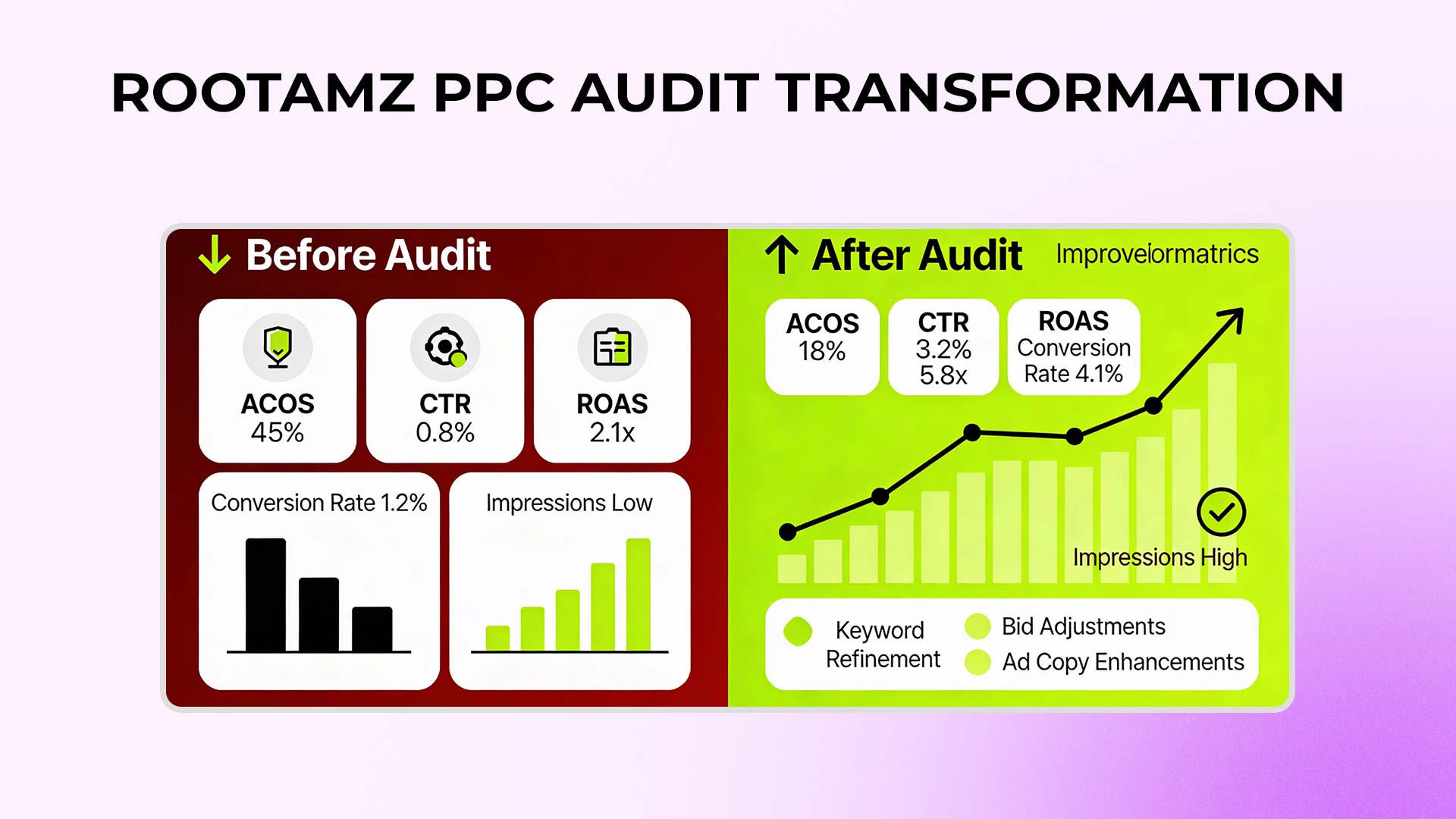
A mid-sized health & beauty brand approached RootAMZ with stagnant sales despite substantial advertising spend. Their campaigns suffered from poor structure, minimal negative keywords & no differentiation between product performance. After implementing a comprehensive audit & restructure, ROAS improved by 67% within eight weeks, whilst maintaining similar visibility.
Another case involved an electronics accessory brand struggling with seasonal fluctuations. RootAMZ implemented dayparting strategies that concentrated spend during high-conversion hours, adjusted bids based on device performance (mobile versus desktop) & created separate campaigns for promotional periods. This strategic approach reduced ACoS by 34% whilst increasing total sales by 28%.
These scenarios illustrate how professional PPC management services transform advertising from a necessary expense into a profitable growth engine. The difference isn’t just technical expertise it’s the strategic framework that connects advertising activity to business outcomes.
Conclusion: Transform Your PPC Performance in 2026
Amazon PPC has evolved far beyond basic keyword targeting. Success in 2026 requires sophisticated tools, strategic expertise & continuous optimisation that responds to changing market conditions. The brands that thrive are those treating PPC as a core growth channel rather than an afterthought.
A comprehensive audit reveals exactly where your current campaigns succeed, where they waste budget & what opportunities you’re missing. Whether you’re struggling with declining ROAS, facing increased competition, or simply wanting to scale efficiently, professional PPC tools & ads management makes the difference between surviving & dominating your category.
RootAMZ brings the strategic framework, technical expertise & commitment to profitability that transforms advertising spend into predictable growth. By focusing on what matters-sustainable returns, not vanity metrics,RootAMZ helps brands build advertising programmes that scale alongside their ambitions.
If you’re ready to stop guessing & start growing, reach out to RootAMZ for a comprehensive PPC audit. Discover what’s possible when advertising strategy meets execution excellence.
FAQ’s
What are PPC tools & how do they work?
PPC tools are software platforms that manage & optimise pay-per-click campaigns by connecting to your advertising accounts, analysing performance data & providing automated bid management, keyword research, competitor analysis & reporting. They save time & identify opportunities human analysis might miss.
How does RootAMZ optimise PPC campaigns?
RootAMZ combines strategic planning with continuous data analysis, starting with comprehensive audits & campaign restructuring. Ongoing optimisation includes performance-based bid adjustments, negative keyword refinement, search term mining & ad copy testing—all focused on improving profitability, not just traffic.
Which platforms does RootAMZ manage ads for?
RootAMZ specialises in Amazon PPC (Sponsored Products, Brands, Display), Google Ads (Shopping, Search, Display) & expanding marketplace platforms including Walmart Advertising, Flipkart Ads & regional eCommerce platforms.
How long does PPC take to show results?
Initial results appear within 2-4 weeks, but meaningful improvements typically require 6-8 weeks as strategies are refined. PPC requires continuous optimisation expect the first quarter to build foundations, with accelerating returns afterwards.
Is PPC suitable for small & large brands?
Yes, PPC scales effectively for all business sizes. Smaller brands compete through strategic targeting, whilst larger brands defend market share & maximise catalogue visibility. Even modest budgets deliver meaningful returns when properly optimised.