The holiday rush is over. Most sellers are catching their breath. But the smartest brands? They’re doubling down.
January isn’t a recovery month. It’s an opportunity month. While your competition slows down, post-holiday shoppers are actively spending & they’re looking for different things than they were in December.
The brands that understand this shift & adapt their strategy accordingly will capture market share that lasts all year. The ones that treat January like an off-season will watch their momentum evaporate.
At RootAMZ, an Amazon Ads Verified Partner, we help brands capitalise on this critical window through:
- Strategic PPC realignment for post-holiday intent
- Listing optimization focused on New Year goals and self-improvement
- Inventory and pricing intelligence to capture demand efficiently
- Conversion-focused content and promotional planning
Let’s break down exactly how to dominate Amazon in January and turn post-holiday shoppers into long-term, high-value customers.
Understanding the Post-Holiday Shopper Mindset
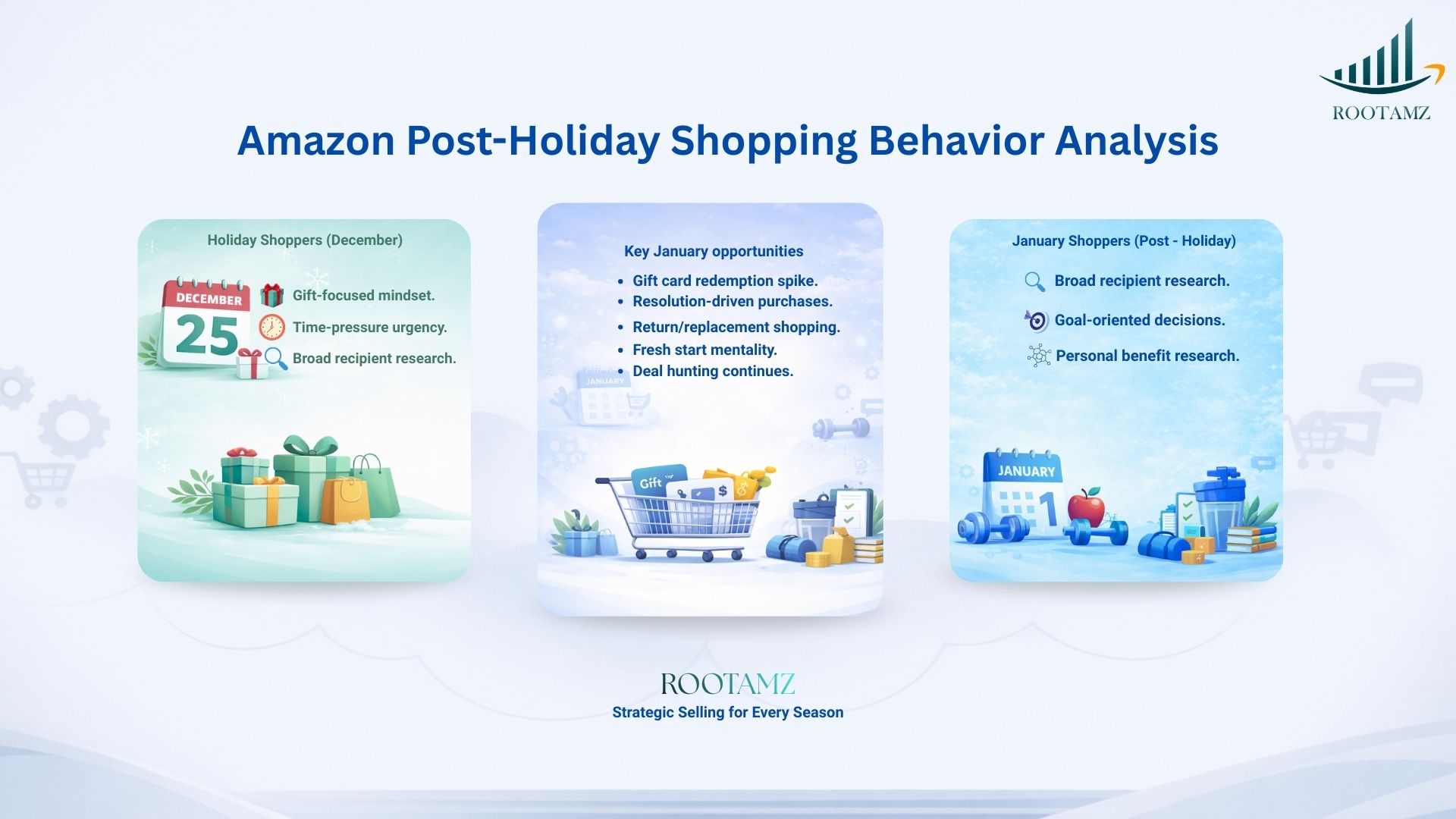
Post-holiday shoppers aren’t the same as holiday shoppers. Their motivations, behaviors & purchasing patterns are completely different.
What drives January shoppers:
Gift card redemption is massive. Millions of Amazon gift cards get activated in late December & early January. These shoppers have money to spend & are actively browsing.
New Year resolutions create specific demand spikes. Fitness equipment, organizational products, self-improvement books, healthy cooking tools, productivity software these categories explode in January.
Return & exchange shoppers are looking for replacements. When holiday gifts don’t fit or aren’t quite right, people come back to Amazon to find the correct version.
Post-holiday sales hunters expect deals. After being trained by Black Friday & Cyber Monday, shoppers in January are still looking for value. But they’re also less rushed, which means they research more carefully.
Fresh start mentality drives new purchases. People are motivated to upgrade their lives, try new things & invest in themselves. This creates opportunities across almost every category.
What you need to understand:
January shoppers are more deliberate than holiday shoppers. They compare options. They read reviews. They care about quality, not just speed.
This means your listings need to be optimised for education & persuasion, not just quick conversions. Your content needs to answer questions, build confidence & demonstrate value.
The brands that win in January are the ones that align their entire strategy inventory, pricing, advertising, content, promotions with this specific shopper psychology.
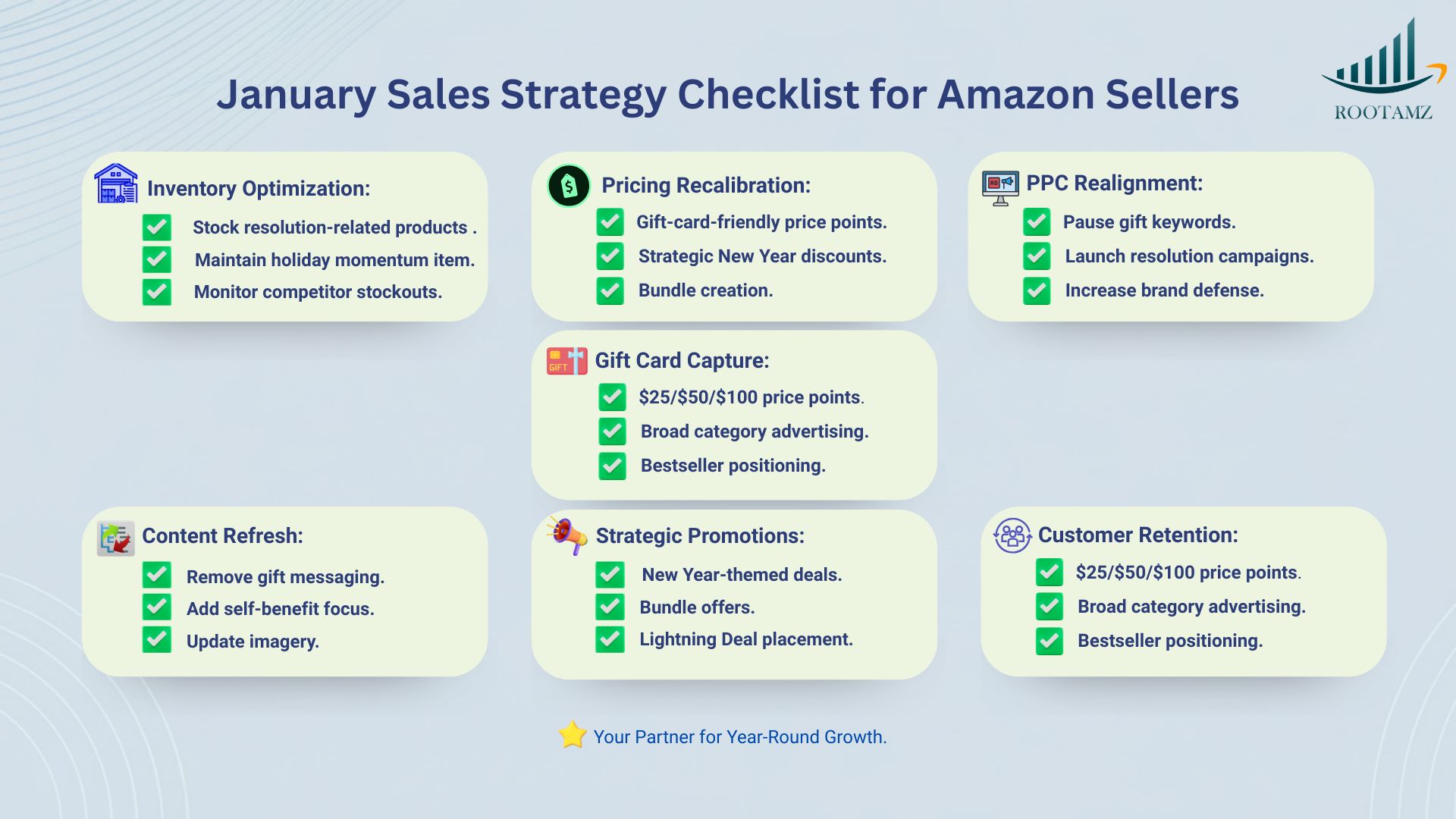
1. Optimise Your Inventory for Post-Holiday Demand
Getting your inventory right in January determines whether you capture opportunity or miss it entirely.
What’s happening with inventory in January:
Many sellers deliberately run low on stock after the holiday push, either to avoid storage fees or because they’re waiting on shipments. This creates visibility gaps you can exploit.
Seasonal products that were in high demand in December often see continued interest in January. Winter clothing, holiday decor storage, gift wrap organisers these products still sell & competition drops.
Resolution-related products experience massive demand surges. If your catalog includes anything related to fitness, organization, productivity, health, learning, or self-improvement, you need full stock.
Your inventory strategy for January:
Identify which of your products align with New Year resolutions & ensure they’re fully stocked. Even if they weren’t your holiday bestsellers, they might be your January winners.
Keep seasonal transition products available. Items that help people organise post-holiday clutter, store decorations, or transition their homes from holiday to everyday are in demand.
Monitor your fast-movers from December & maintain stock. If products performed well during the holiday rush, don’t let them go out of stock now. Momentum matters.
Use Amazon’s restock recommendations cautiously. The algorithm doesn’t always account for post-holiday behavior shifts. Your category knowledge should override automated suggestions.
Watch for competitor stockouts. When major competitors run low, that’s your opportunity to capture their traffic. Make sure you’re there when they’re not.
The RootAMZ approach:
We analyse historical post-holiday performance patterns to predict January demand surges. Our inventory intelligence system identifies which products need aggressive restocking & which can run leaner, ensuring you capture maximum sales without tying up unnecessary capital in slow-movers.
2. Recalibrate Your Pricing Strategy
Holiday pricing doesn’t work in January. The context has changed & your pricing needs to reflect that.
What’s different about January pricing:
Shoppers expect deals but aren’t panicking. They’ll wait for the right price, but they’re also making considered purchases. This creates space for strategic discounting rather than aggressive slashing.
Gift card spenders often have specific amounts to work with. Products priced at common gift card values ($25, $50, $100) perform particularly well.
Bundle opportunities increase. Shoppers starting fresh with new goals are often willing to buy complete solutions rather than individual items.
Perceived value matters more than absolute price. A product priced at $39.99 with strong reviews & complete features will outperform a $29.99 option with mediocre reviews.
Your pricing strategy for January:
Test strategic discounts on resolution-aligned products. A 15-20% discount on fitness, organisation, or self-improvement items can drive significant volume without destroying margins.
Create New Year bundles. Package complementary products together at a slight discount. This increases average order value while giving shoppers the “deal” feeling they’re looking for.
Use Lightning Deals & Deal of the Day strategically. These placements get massive visibility in January when competition for them decreases. Focus them on high-margin or high-inventory products.
Consider gift-card-friendly pricing. If your product is $48, test whether moving it to $49.99 (just under $50) improves conversion from gift card shoppers.
Monitor competitor pricing daily. January is when pricing gaps create opportunities. If competitors raise prices as they restock, you can capture their traffic with better value positioning.
The RootAMZ approach:
Our pricing intelligence team monitors your category’s competitive landscape in real-time, identifying opportunities where strategic price adjustments can capture market share without sacrificing profitability. We test bundle configurations & promotional pricing to find the sweet spot between conversion & margin.
3. Realign Your PPC Campaigns for January Search Behavior
Holiday keywords don’t work in January. Search behavior shifts dramatically & your advertising needs to shift with it.
What changes in January search behavior:
“Gift” keywords drop off. “For him,” “for her,” “stocking stuffer,” “Christmas gift”—all these modifiers that drove December traffic become irrelevant.
Resolution-related keywords spike. “New Year,” “fitness goals,” “organization,” “self-improvement,” “healthy,” “productivity” these modifiers become gold.
Brand search increases. After receiving products as gifts, people search for specific brands to buy accessories, refills, or upgrades.
Research-focused searches grow. “Best,” “review,” “comparison,” “vs”—these keywords indicate shoppers in research mode, not panic-buying mode.
Your PPC strategy for January:
Pause or dramatically reduce bids on gift-related keywords immediately. Don’t waste budget on search terms that no longer convert.
Launch dedicated campaigns targeting New Year & resolution-related modifiers. Add “new year,” “resolution,” “2026,” “fresh start” to your core product keywords.
Increase brand defense spending. If people received your product as a gift & search for your brand, you need to own that placement. Don’t let competitors steal your brand traffic.
Target competitor brands more aggressively. January is when people research alternatives to products they received. Competitive targeting can capture shoppers considering upgrades or replacements.
Focus on educational & comparison keywords. Target “how to choose,” “what to look for,” “guide,” & similar terms that indicate research behavior.
Test video ads. January shoppers take more time to research. Video ads that demonstrate your product’s value proposition perform particularly well.
The RootAMZ approach:
As an Amazon Ads Verified Partner, we execute comprehensive campaign realignments in early January, shifting budget from holiday keywords to resolution-focused terms. Our team identifies category-specific search trends & adjusts bidding strategies to capture post-holiday traffic at optimal efficiency.
4. Refresh Your Listing Content for Post-Holiday Relevance
Your December listing content was optimized for gift buyers. January shoppers need different information.
What January shoppers want to see:
Self-benefit messaging over gift messaging. In December, you emphasized “perfect gift for.” In January, emphasize “achieve your goals,” “upgrade your routine,” “invest in yourself.”
Results & outcomes over features. Resolution-driven shoppers want to know what they’ll achieve, not just what they’ll get. Show transformation, not just specifications.
Quality & durability signals. Post-holiday shoppers are spending their own money (or gift cards) & want products that last. Emphasize build quality, warranties & longevity.
Compatibility & integration information. If your product works with other systems or products, make that clear. January is when people build out their ecosystems.
Your content strategy for January:
Update your main image if possible. If your December image showed gift packaging or holiday themes, replace it with a clean product shot that emphasises use & benefit.
Rewrite your title to remove gift language. “Perfect Gift” should become “Professional Grade” or similar benefit-focused language.
Refresh your bullet points to emphasise self-improvement & results. Lead with outcomes, not features. “Achieve Your Fitness Goals” works better than “Includes Resistance Bands.”
Add New Year-relevant A+ content. Create a module specifically addressing resolution-related use cases. Show before-and-after scenarios. Highlight success stories.
Update your product description to speak to January motivations. Reference fresh starts, new goals & personal improvement rather than gift-giving occasions.
Enhance your image stack with lifestyle photos showing real use. January shoppers want to visualise themselves using the product, not giving it as a gift.
The RootAMZ approach:
Our content team executes rapid listing optimizations in early January, realigning messaging, imagery & A+ content to match post-holiday shopper psychology. We maintain listing quality scores while shifting the narrative to capture resolution-driven traffic.
5. Launch Strategic Promotions That Convert January Shoppers
Generic discounts aren’t enough. January shoppers respond to specific promotional psychology.
What works in January promotions:
New Year-themed messaging. “New Year, New You” isn’t cliche it’s effective. Use it.
Limited-time urgency. “Start 2026 right” & “limited New Year offer” create deadline pressure without feeling artificial.
Bundle deals that support goals. “Complete Home Gym Starter Kit” or “Total Organization System” bundles sell better than individual item discounts.
Tiered discounts. “Buy 2, save 15%, buy 3, save 25%” works particularly well for consumables & products people stockpile.
Free accessories or bonuses. “Free resistance bands with purchase” adds perceived value without cutting your price.
Your promotion strategy for January:
Run a New Year launch promotion in the first two weeks of January when resolution motivation is highest. This captures peak intent.
Create category specific bundles. Group products that support complete solutions for common resolutions.
Use percentage off coupons prominently. The coupon badge increases visibility in search results when competition is lower.
Test Subscribe & Save promotions. January is when people commit to new routines. Subscription products that support ongoing goals perform particularly well.
Offer social proof incentives. “Join 10,000+ customers achieving their 2026 goals” type messaging increases conversion.
The RootAMZ approach:
We design & execute promotional calendars that maximize January traffic while protecting margins. Our team tests various promotional structures to identify which resonates best with your specific category & customer base then scales the winners aggressively.
6. Capture Gift Card Traffic Strategically
Amazon gift cards represent billions in January purchasing power. Capturing that traffic requires specific tactics.
Understanding gift card shopper behaviour:
They have specific amounts to spend. Gift cards come in $25, $50, $100 increments. Shoppers often search for products at those price points.
They’re browsing broadly. Gift card recipients often explore categories they don’t normally shop, creating cross-category opportunities.
They’re less price-sensitive. It’s “free money” psychology. Gift card shoppers convert at higher rates than regular shoppers.
They redeem quickly. Most gift cards get used within 30 days. Early January is peak redemption time.
Your gift card capture strategy:
Ensure you have products at key price points. Having offerings at $24.99, $49.99 & $99.99 specifically targets gift card amounts.
Advertise in adjacent categories. If you sell fitness products, advertise in health, wellness & lifestyle categories where gift card browsers might be exploring.
Use broad match keywords strategically. Gift card shoppers often use general search terms. Broad match can capture this exploratory traffic.
Highlight “bestseller” & “highly rated” badges. Gift card shoppers who are exploring unfamiliar categories rely heavily on social proof.
Create “Gift Card Redemption” marketing messages. Simple “Perfect way to use your Amazon gift card” messaging can be surprisingly effective.
The RootAMZ approach:
We identify gift card redemption patterns in your category & adjust advertising strategies to capture that high-intent traffic. Our team optimises product positioning & pricing to align with common gift card denominations, maximising conversion from this valuable January traffic source.
7. Build Long-Term Customer Relationships from January Sales
January shoppers aren’t just one-time buyers. They’re starting new routines, which creates repeat purchase opportunities.
Why January customers are valuable:
Resolution-driven purchases often require replenishment. Fitness supplements, organizational supplies, self-care products these create subscription opportunities.
January buyers are trying new brands. If you deliver value, you can convert them into long-term customers who wouldn’t have discovered you otherwise.
Goal-oriented customers have higher lifetime value. People investing in self-improvement are generally higher-engagement, higher-spending customers.
Your customer retention strategy for January:
Include inserts that support ongoing success. A “30-Day Goal Achievement Guide” or similar resource adds value & keeps customers engaged with your brand.
Set up automated follow-up sequences. Email customers after purchase with tips, usage guides & complementary product recommendations.
Encourage Subscribe & Save enrolment. Make it easy for customers to set up recurring orders for consumable products.
Request reviews strategically. Ask for reviews after customers have had enough time to see results, not immediately after delivery.
Create exclusive customer communities. Facebook groups or email lists focused on achieving specific goals build loyalty & repeat purchases.
The RootAMZ approach:
Our customer experience team designs post-purchase journeys that convert January buyers into long-term brand advocates. We implement review request timing optimization, subscription conversion funnels & customer communication sequences that maximize lifetime value from post-holiday shoppers.
The January Advantage: Why This Matters for Your Entire Year
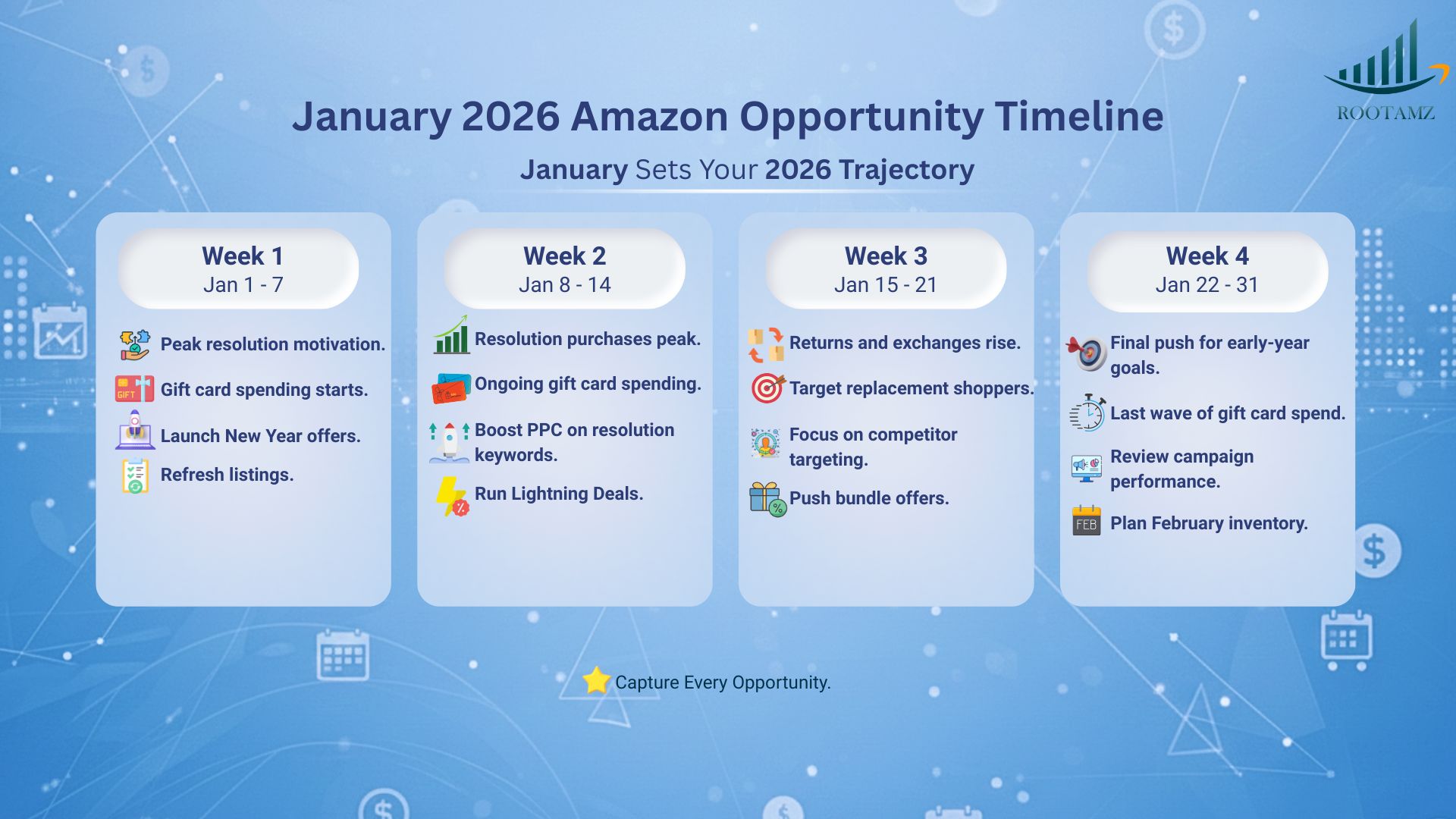
Here’s what most sellers miss: January performance sets your trajectory for the entire year.
Why January success compounds:
Algorithm momentum carries forward. Strong January sales improve your Best Seller Rank, which influences visibility for months.
Review velocity increases. More January sales mean more reviews in February & March, strengthening your listing during prime Q1 selling season.
Customer acquisition in January is cheaper. Lower competition means better advertising efficiency. You’re getting customers at a lower CAC than you will in Q2 or Q3.
Brand awareness compounds. Shoppers who discover you in January become brand searchers later. This creates organic traffic growth throughout the year.
Inventory confidence grows. Strong January performance gives you data to make better inventory decisions for the rest of Q1.
What this means strategically:
January isn’t cleanup time. It’s investment time. The brands that treat January like a major selling season position themselves for year-long success.
The ones that coast through January spend the rest of the year playing catch-up.
Final Takeaway: Post Holiday Shoppers Are Your 2026 Foundation
January shoppers are motivated, deliberate & valuable. They’re starting fresh, setting goals & investing in themselves.
The brands that capture this traffic aren’t just making January sales. They’re building customer relationships that drive revenue all year.
But you need a specific strategy. Holiday tactics don’t work. Generic promotions aren’t enough. You need inventory, pricing, advertising, content & promotions aligned with post-holiday psychology.The opportunity is massive. The window is short. The competition is sleeping.
FAQ’S
Why is January important for Amazon sellers after the holidays?
January is a high-opportunity month driven by gift card redemptions, New Year resolutions & return/replacement purchases. Competition drops, CPCs fall & strong January sales build algorithm momentum, reviews & lower acquisition costs for the rest of 2026.
How should PPC campaigns change for post-holiday shoppers?
Pause gift-related keywords & shift to resolution-focused terms like “New Year,” “2026,” & “fresh start.” Increase brand defense, target competitors, use educational keywords & test video ads to capture research-driven shoppers with lower CPCs.
What promotions work best in January?
New Year messaging, goal-based bundles, tiered discounts, gift-card-friendly pricing & Subscribe & Save offers perform best. Limited-time New Year deals & Lightning Deals drive urgency without heavy discounting.
Should product listings be updated for January?
Yes. Remove gift-focused language & highlight benefits, results & durability. Update images, bullets & A+ content to focus on self-improvement & real-use scenarios to improve conversions.
How does RootAMZ help brands maximize January sales?
RootAMZ realigns PPC, refreshes listings, optimises inventory & builds retention strategies to capture January demand & create long-term growth momentum for 2026.