Amazon FBA Storage Fees: Strategic Management Guide
Amazon FBA long-term storage fees represent one of the most overlooked yet controllable expenses for marketplace sellers. While many focus on referral fees & advertising costs, storage fees silently erode profit margins for sellers who don’t actively manage inventory age & turnover. At RootAMZ, we help sellers implement strategic inventory management practices that eliminate these unnecessary costs while maximising profitability.
Understanding Amazon’s Storage Fee Structure
Amazon charges storage fees to incentivize sellers to maintain fast-moving inventory. The fee structure penalises products sitting in fulfilment centres for extended periods.
Monthly Storage Fees
Standard monthly storage fees apply to all FBA inventory based on cubic feet occupied. From January through September, rates are $0.87 per cubic foot for standard-size items & $0.56 per cubic foot for oversize items. During October through December peak season, rates increase to $2.40 & $1.40 respectively.
Long-Term Storage Fees
Long-term storage fees apply when inventory remains in Amazon fulfilment centres for more than 365 days. Amazon assesses these fees on the 15th of each month, charging $6.90 per cubic foot or $0.15 per unit, whichever is greater.
For context, a standard box measuring 18x14x8 inches occupies approximately 0.91 cubic feet. Over a year, that single box costs $75+ in long-term storage fees alone.
Impact on Profitability & IPI Scores
Storage fees create a double profit hit. First, you pay direct fee expenses, reducing margins. Second, capital remains locked in non-selling inventory that could be invested in productive stock generating revenue.
Amazon’s Inventory Performance Index (IPI) score directly affects storage limits & fees. Sellers with IPI scores below 500 face storage volume restrictions. Aged inventory significantly damages IPI scores, creating a cycle where poor inventory management restricts your ability to bring in profitable new products. RootAMZ helps sellers maintain optimal IPI scores through proactive inventory monitoring & strategic intervention.
Strategic Inventory Planning
Demand & Forecasting
RootAMZ recommends purchasing inventory in quantities supporting 60-90 days of sales based on historical velocity & seasonal trends. Use Amazon’s Sales Dashboard to calculate average daily units sold over the past 90 days. If a product sells 10 units daily, a 60-day supply equals 600 units. Quantities exceeding 90-120 days of projected sales create elevated risk of aged inventory.
Factor lead times into purchasing decisions. If your supplier requires 45 days from order to Amazon receipt, initiate replenishment when stock drops to 60-75 days remaining.
Seasonal Planning
For seasonal items, aggressive pre-season marketing & competitive pricing maximize sales during peak Demand & windows. As seasons end, immediately discount remaining inventory clearing stock before it ages 90+ days. Plan seasonal inventory arrivals 30-45 days before peak sales periods, not 90-120 days earlier.
Active Inventory Management
The 270-Day Action Threshold
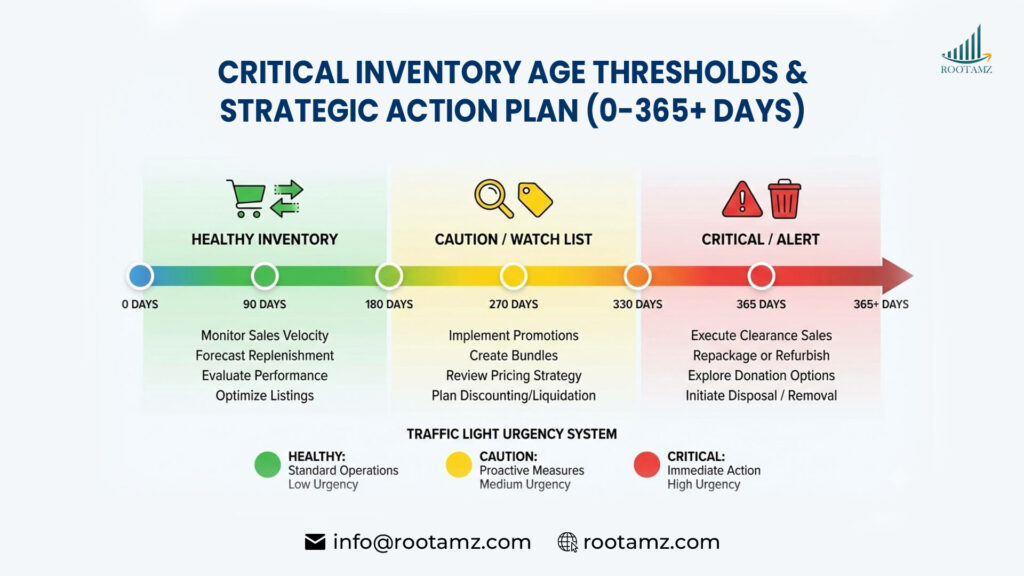
Review your FBA Inventory Age report monthly, identifying products approaching 270-330 days in storage. When products reach 270 days, implement immediate intervention. You have 90 days before long-term fees begin. RootAMZ’s inventory management approach emphasises proactive monitoring at this critical 270-day threshold to prevent costly long-term storage fees.
Evaluate each aged product’s recovery potential. Calculate break even scenarios comparing storage fee costs against potential recovery through sales.
Pricing Strategies
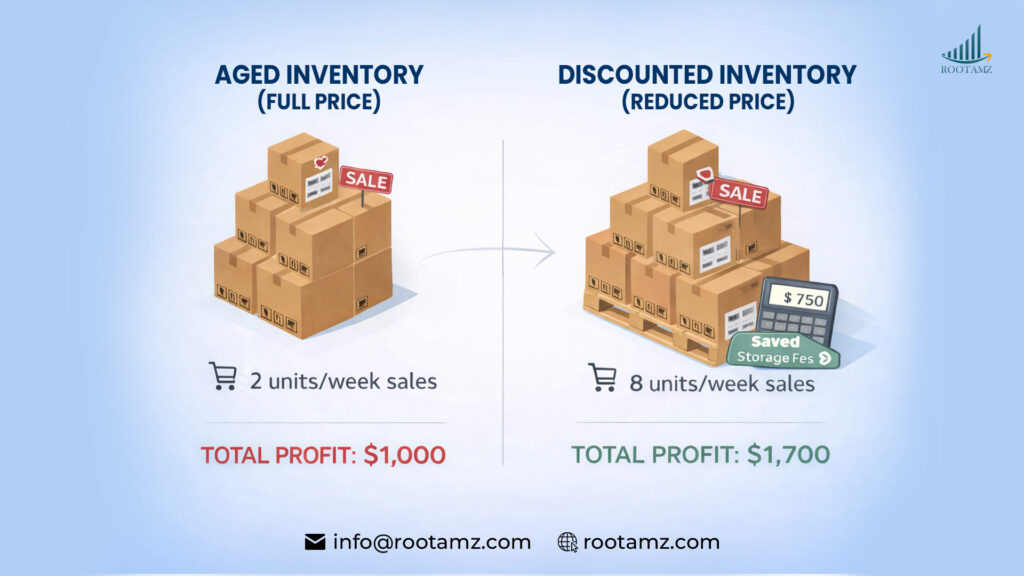
Discount aged inventory to levels driving velocity increases sufficient to deplete stock before long-term storage fees begin. If a product currently priced at $39.99 sells 2 units weekly, discounting to $29.99 might increase velocity to 6 units weekly, depleting inventory in 17 weeks instead of 50 weeks while recovering more total profit despite lower per-unit margins.
Start with 15-20% reductions testing velocity response, then increase discounts incrementally until achieving target depletion rates.
Lightning Deals & Promotions
Amazon’s Lightning Deals & promotional placements generate massive visibility spikes perfect for clearing aged inventory. Submit aged inventory for promotional opportunities 90-120 days before reaching long-term storage thresholds.
Inventory Removal Options
When to Pull Inventory
Create removal orders when storage fees & opportunity costs exceed potential profit from eventual sales. Amazon charges $0.50-$0.60 per unit for standard-size removal. If 500 units would cost $800 in storage fees over 12 months, paying $275 for removal makes financial sense if you can liquidate removed inventory for $200+.
FBA Liquidations Program
Amazon’s FBA Liquidations program sells your aged inventory to wholesale liquidators, recovering 5-10% of average selling price while eliminating storage fees. While recovery rates are low, it provides immediate resolution for aged inventory with poor sales prospects.
Multi-Channel Strategies
Merchant-Fulfilled Listings
Products with low sales velocity (less than 1 unit daily) often perform acceptably as merchant-fulfilled listings avoiding FBA storage fees entirely. Implement hybrid strategies maintaining FBA inventory for fast-moving products while fulfilling slow movers from your warehouse.
Multi-Channel Fulfilment
Multi-Channel Fulfilment allows using FBA inventory to fulfil orders from other sales channels like Shopify or eBay. Products aging in FBA might sell better on alternate platforms with different customer Demographics.
Technology & Automation
Inventory Management Software
RootAMZ integrates with third-party inventory management systems & Amazon Seller Central, providing automated alerts when products approach critical thresholds (270, 330, 365 days) & decision support data including storage fee projections & velocity trend analysis.
Automated Repricing
Repricing tools automatically adjust prices on aged inventory based on configurable rules. Set rules reducing prices by 5% when inventory reaches 270 days, additional 10% at 300 days & aggressive 25%+ discounts at 330 days, ensuring systematic intervention preventing long-term storage fees.
Conclusion
Long-term storage fees are entirely preventable with proper planning & active management. Partner with RootAMZ to implement strategic inventory practices protecting margins & positioning your business for sustainable growth. Don’t let controllable costs erode your hard-earned profits.
✅ Amazon FBA Storage Fees: Manage Inventory Smarter in 2026.
FAQ’s
At what point does inventory incur long-term storage fees?
Inventory stored in Amazon fulfillment centers for more than 365 days becomes subject to long-term storage fees. Amazon assesses these fees monthly on the 15th for units exceeding the 365-day threshold.
How can I check which products are approaching long-term storage?
Review the FBA Inventory Age report in Seller Central monthly. Focus on products in the 271-365 day age bracket, as these approach long-term storage fee thresholds & require immediate intervention.
What's the best strategy for clearing aged FBA inventory?
Implement tiered discounting starting at 270 days, use Lightning Deals & promotional events to generate visibility spikes, increase advertising on aged products, or create removal orders when storage costs exceed potential profit from eventual sales.
How do storage fees affect my Amazon IPI score?
Aged inventory & excess inventory significantly reduce IPI scores. Sellers with IPI below 500 face storage volume restrictions. Maintaining aggressive aged inventory management keeps IPI scores healthy, typically above 550, ensuring unrestricted storage capacity.